
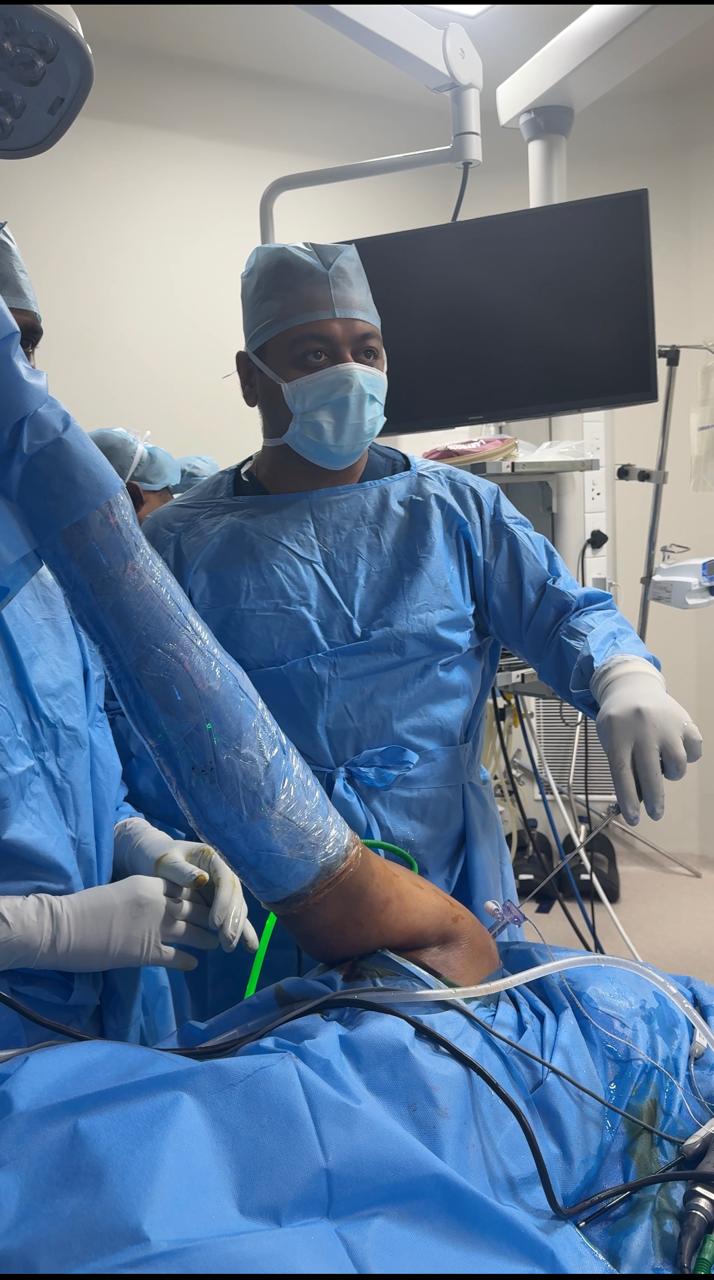
A torn biceps tendon can cause sudden pain, weakness, bruising, and difficulty using the arm normally. For active adults, athletes, and people whose work involves lifting, one of the first questions after diagnosis is: How long will recovery take after biceps tendon repair? Recovery is gradual. The repaired tendon needs time to heal securely to the bone before heavier loading can begin. While timelines vary according to the location and severity of the tear, surgical technique, age, activity level, and rehabilitation, many patients require approximately 4–6 months before returning to unrestricted higher-level activity. Some may need longer before returning to heavy lifting or competitive sports. If you are considering biceps tendon rupture treatment in Bangalore, understanding the recovery stages can help you prepare for surgery and rehabilitation.
Understanding a Biceps Tendon Tear
The biceps muscle at the front of the upper arm is attached by tendons near the shoulder and elbow. Tears are broadly classified according to their location.
Proximal Biceps Tendon Tear
This occurs near the shoulder, commonly involving the long head of the biceps tendon. Some proximal tears can be treated without surgery, depending on symptoms, associated shoulder problems, functional requirements, and patient expectations.
Distal Biceps Tendon Tear
A distal biceps tear occurs near the elbow. Complete distal tears can significantly reduce strength, particularly when rotating the forearm palm-up (supination). For active individuals who need to regain strength and function, surgical repair may be recommended. Assessment by a distal biceps repair specialist in Bangalore can help determine the appropriate treatment.
Symptoms of a Torn Biceps Tendon
A biceps tendon rupture may occur suddenly during lifting or another forceful movement. Symptoms can include:
-
Sudden Pain: Sudden pain in the shoulder or front of the elbow
-
Popping Sensation: A popping or snapping sensation during injury
-
Bruising & Swelling: Bruising and swelling around the arm
-
Elbow Weakness: Weakness while bending the elbow
-
Forearm Weakness: Weakness when rotating the forearm (supination)
-
Contour Change: A visible change in the contour of the biceps muscle ("Popeye deformity")
-
Cramping & Fatigue: Cramping or fatigue with repetitive activity
The symptoms differ depending on whether the injury involves the proximal or distal tendon.
How Is a Biceps Tendon Tear Diagnosed?
Diagnosis starts with a detailed clinical examination. The orthopaedic surgeon evaluates the appearance of the arm, tenderness, strength, range of movement, and specific movements that stress the biceps tendon. Imaging may include:
-
Ultrasound: Can help assess tendon continuity and identify a rupture.
-
MRI: Provides detailed information about the tendon, location and extent of the tear, retraction, and associated injuries.
-
X-Rays: Although tendons are not clearly visible on X-rays, they may be used to evaluate the surrounding bones or rule out other injuries.
Does Every Biceps Tendon Tear Need Surgery?
No. Some proximal biceps tendon tears can be managed with activity modification, pain management, and physiotherapy, particularly when functional loss is limited. Complete distal biceps ruptures are more likely to be considered for surgical repair in active patients because leaving the tendon detached can result in persistent loss of strength, particularly with forearm rotation. The decision should therefore be based on the type of tear, degree of functional impairment, age, occupation, sporting requirements, associated injuries, and individual goals rather than the diagnosis alone.
What Is Biceps Tendon Repair Surgery?
During biceps tendon repair, the torn tendon is reattached to the appropriate bone using surgical fixation techniques. For a distal biceps rupture, this usually involves restoring the tendon attachment near the elbow. For certain proximal biceps problems near the shoulder, treatment may involve a procedure such as biceps tenodesis, where the tendon is secured to the upper arm bone rather than simply repaired in its original location. The exact procedure depends on the location and nature of the injury.
Biceps Tendon Repair Recovery Timeline
Patients searching for biceps tendon repair recovery time in Bangalore should remember that rehabilitation is based on biological tendon healing rather than pain alone. Feeling better does not necessarily mean the tendon is ready for heavy loading. A typical recovery may progress as follows.
Weeks 0–2: Protection and Early Healing
The primary goal during the first two weeks is protecting the repair. Depending on the procedure, the arm may be supported in a sling or brace. Swelling, bruising, and discomfort are expected to gradually improve. Patients should avoid lifting, pulling, pushing, or movements that place excessive tension on the repaired tendon. Hand, wrist, or other permitted movements may be started according to the surgeon’s rehabilitation protocol.
Weeks 2–6: Controlled Movement
During this period, rehabilitation usually focuses on gradually restoring movement while continuing to protect the tendon. Physiotherapy may include controlled passive or assisted exercises. Restrictions on active elbow flexion or resisted biceps activity may remain, particularly following distal biceps repair. The exact progression depends on the type of repair.
Weeks 6–12: Regaining Movement and Beginning Strength
As tendon healing progresses, patients may gradually transition toward more active movement. Light strengthening may begin when the surgeon and physiotherapist consider the repair sufficiently healed. The goal is to progressively restore:
-
Range of Motion: Range of motion restoration
-
Muscle Control: Neuromuscular control
-
Functional Use: Functional use of the arm
-
Strength: Shoulder and elbow strength
Heavy lifting is generally still avoided.
Months 3–4: Progressive Strengthening
Strengthening becomes more important during this phase. Exercises can be progressively advanced to rebuild biceps, shoulder, elbow, forearm, and surrounding muscle strength. Patients with physically demanding occupations may require a structured work-conditioning programme before returning to unrestricted duties.
Months 4–6: Return to Higher-Level Activity
Many patients can gradually return to more demanding exercise and sporting activities during this period if strength, movement, and tendon healing are satisfactory. Return to heavy gym exercises should be gradual rather than immediately returning to pre-injury weights.
6 Months and Beyond
Some patients—particularly competitive athletes, heavy manual workers, or those recovering from complex injuries—may require 6 months or longer before unrestricted activity. Recovery should be based on clinical assessment, strength, function, and the surgeon’s clearance rather than a fixed date alone.
When Can You Return to the Gym After Biceps Tendon Repair?
Returning to the gym too early can place excessive stress on the healing tendon. Lower-body exercises or activities that do not load the repaired arm may sometimes be introduced earlier with medical clearance. Direct biceps loading, heavy pulling, curls, deadlifts, pull-ups, and similar exercises generally require a more cautious progression. For many patients, heavier resistance training is considered only after several months of rehabilitation. Your surgeon and physiotherapist should determine when your repair is ready for specific exercises.
Why Is Physiotherapy Important?
Physiotherapy is an important part of biceps tendon repair recovery. Rehabilitation helps patients regain movement while protecting the repair during its vulnerable early stages. Later, therapy focuses on rebuilding strength, endurance, coordination, and confidence. Trying to progress too quickly can risk stressing the repair, while excessive immobilisation can contribute to stiffness and weakness. A structured rehabilitation programme balances these two concerns.
Frequently Asked Questions
1. What are the symptoms of a torn biceps tendon?
Symptoms may include sudden pain, a popping sensation, bruising, swelling, weakness, cramping, and a visible change in the shape of the biceps. Distal tears can particularly affect forearm rotation strength.
2. What causes a biceps tendon rupture?
Biceps tendon ruptures can occur during sudden heavy lifting, forceful eccentric loading, falls, sports injuries, or other trauma. Tendon degeneration over time can also increase susceptibility to tearing.
3. Does a biceps tendon tear always require surgery?
No. Some proximal tears can be successfully treated without surgery. Complete distal tears in active individuals are more commonly considered for surgical repair because of potential persistent strength loss.
4. How is a biceps tendon tear diagnosed?
Diagnosis usually involves clinical examination and may be confirmed with ultrasound or MRI. Imaging also helps determine the location and extent of the tear.
5. What is biceps tendon repair surgery?
Biceps tendon repair involves surgically restoring the torn tendon attachment. The technique depends on whether the injury involves the shoulder-side or elbow-side attachment of the biceps.
6. How long does biceps tendon repair take to heal fully?
Tendon healing occurs gradually over several months. Many patients progress toward unrestricted activities around 4–6 months, although complete recovery can take longer depending on the injury, procedure, rehabilitation, and activity demands.
7. What is the recovery timeline week by week after biceps repair?
The first few weeks focus on protecting the repair. Controlled movement is gradually introduced, followed by active movement and strengthening over approximately 6–12 weeks. More demanding strengthening usually follows during months 3–4, with progressive return to sports or heavier activity often occurring around months 4–6 or later.
8. When can I return to the gym or sports after biceps tendon repair?
Return depends on tendon healing, strength, range of motion, and the type of activity. Heavy biceps loading and contact or high-demand sports may require several months and should only resume after medical clearance.
9. What restrictions apply after biceps tendon surgery?
Early restrictions commonly include avoiding lifting, pulling, pushing, resisted elbow bending, and other activities that load the repaired tendon. Restrictions vary according to the surgical procedure and stage of healing.
10. Is physiotherapy necessary after biceps tendon repair?
Yes. Structured physiotherapy is usually an important component of recovery because it helps restore movement and strength while progressively and safely loading the repaired tendon.
11. What happens if a biceps tendon tear is left untreated?
The consequences depend on the location and severity of the tear. Some proximal tears cause relatively limited functional problems. An untreated complete distal rupture can result in persistent weakness, particularly during forearm supination, as well as fatigue or changes in muscle contour.
12. Can a biceps tendon tear heal without surgery?
Some partial or proximal tears can be managed successfully without surgery. A completely detached distal biceps tendon generally does not restore its normal anatomical attachment without surgical repair.
13. What are the risks of biceps tendon repair surgery?
Potential risks include infection, stiffness, nerve irritation or injury, persistent pain, weakness, heterotopic bone formation in some distal repairs, fixation problems, or re-rupture. Your surgeon can explain the risks relevant to the specific procedure being considered.
14. Who performs biceps tendon repair surgery in Bangalore?
Biceps tendon injuries are generally treated by orthopaedic surgeons with expertise in shoulder, elbow, sports medicine, and tendon injuries. Dr. Pradyumna R provides evaluation and treatment for biceps tendon injuries in Bangalore, including assessment of proximal and distal biceps tears and determining when surgical repair may be appropriate. Patients looking for biceps tendon surgery in Bangalore, a distal biceps repair specialist in Bangalore, or a shoulder biceps tendon doctor in Bangalore can seek specialist evaluation based on the type and severity of their injury.
Consult Dr. Pradyumna R for Biceps Tendon Injuries in Bangalore
A suspected biceps rupture should be evaluated early, particularly when there is sudden bruising, deformity, or loss of strength. Early assessment is especially important for complete distal biceps ruptures because timing can influence surgical planning.
Dr. Pradyumna R
Consultant Orthopaedic Surgeon | Knee &
Shoulder Surgery | Sports Medicine | Arthroscopy | Joint Replacement
Bangalore Orthopaedic Clinic
#450, Ground Floor, 6th Main, 7th Cross Mico Layout (Opposite Third Wave Coffee) BTM Layout 2nd
Stage Bengaluru, Karnataka – 560076
Appointments: +91 91130 25188