
/
Quick Answer: What is meniscal surgery and when is it necessary?
Meniscal surgery is a keyhole arthroscopic procedure used to fix or trim a torn crescent-shaped cartilage shock absorber inside the knee joint. Performed by leading meniscal surgeon Dr. Pradyumna R in Bangalore, surgery is recommended when a tear causes severe knee locking, persistent joint line pain, catching, swelling, or failure to heal with conservative physical therapy protecting the knee joint from premature osteoarthritis.
What is Meniscal Surgery?
Meniscal surgery is a minimally invasive keyhole (arthroscopic) joint-preservation operation designed to treat tears in the medial or lateral meniscus the C-shaped rubbery cartilage discs that cushion your knee joint.
Depending on the tear location, blood supply, and tissue quality, the procedure involves either:
- Meniscus Repair: Stitching the torn cartilage back together using advanced all-inside suture anchors to preserve natural cartilage.
- Partial Meniscectomy: Trimming away only the frayed, unrepairable loose flap to smooth the joint surface.
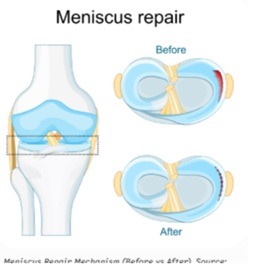
Meniscus Repair Mechanism (Before vs After)
Meniscus Tear Types & Surgical Pathways
Red Zone Tear
(Vascular Edge - High Blood Supply)
Meniscus Repair
(All-Inside Suture Preservation)
(All-Inside Suture Preservation)
White Zone Tear
(Avascular Center - No Blood Supply)
Partial Meniscectomy
(Minimal Trimming Of Loose Flap)
(Minimal Trimming Of Loose Flap)
Symptoms or Signs of a Meniscus Tear
A meniscal tear can occur suddenly during high-impact sports or develop gradually over time due to age-related tissue wear.
Common Symptoms
-
Pain along the Joint Line: Sharp or aching pain directly on the inner (medial) or outer (lateral) side of the knee joint.
-
Knee Locking or Catching: The physical inability to fully straighten or bend the leg because a torn cartilage flap gets physically trapped inside the joint mechanism.
-
Delayed Swelling & Stiffness: Swelling that develops 12 to 24 hours after injury or physical activity.
-
Clicking or Popping Sensation: Audible or felt clicking when squatting, twisting, or climbing stairs.
-
Giving Way: Sensation that the knee joint is buckling or unstable under weight.
Urgent Warning Signs - Seek Prompt Evaluation:
Flex-Locked Knee: If your knee is mechanically stuck at an angle and cannot be extended, this indicates a displaced bucket-handle meniscus tear requiring urgent arthroscopic reduction.
Acute Swelling with Fever: Rapid swelling accompanied by warmth or fever warrants immediate clinical evaluation.
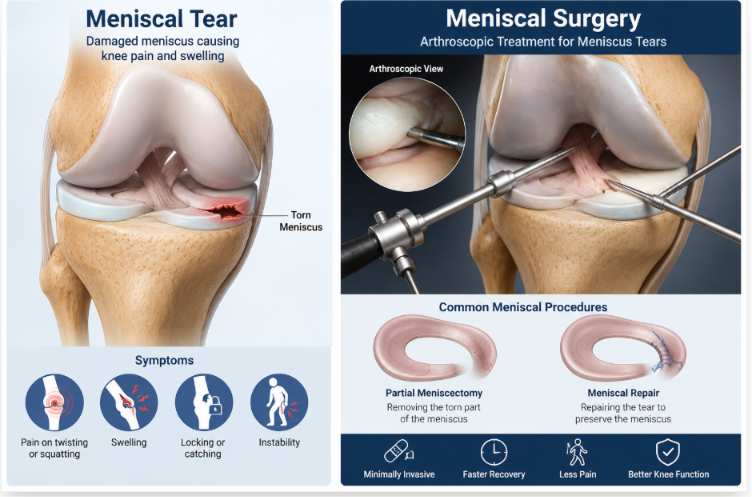
Meniscal Tear Symptoms & Arthroscopic Treatment Overview
Why Choose Dr. Pradyumna for Meniscus Surgery in Bangalore?
Choosing the right orthopaedic surgeon plays a vital role in achieving the best possible outcome after a meniscus injury. Dr. Pradyumna R combines international fellowship training with extensive experience in arthroscopic knee surgery to provide evidence-based, patient-centred care.
Why patients choose Dr. Pradyumna
-
Fellowship-Trained in Arthroscopy & Sports Medicine
-
International Fellowship in Shoulder & Elbow Surgery (TU Munich, Germany)
-
FIFA Diploma in Football Medicine
-
15+ Years of Clinical Experience
-
2,000+ Arthroscopic Knee Procedures
-
Expertise in Meniscus Repair & Joint Preservation
-
Advanced All-Inside Arthroscopic Repair Techniques
-
Comprehensive Rehabilitation Guidance
-
Cashless Insurance Assistance
-
Consultation at Bangalore Orthopaedic Clinic & Manipal Hospitals
Dr. Pradyumna's Clinical Perspective
"One of the most common misconceptions I see is that every meniscus tear requires surgery. In reality, treatment depends on the type, location, and severity of the tear, as well as the patient's symptoms and activity level. Whenever possible, I aim to preserve the natural meniscus because it plays a crucial role in protecting the knee joint from early arthritis. Early diagnosis and the right treatment plan often lead to better long-term outcomes."
What to Expect During Your Treatment Journey
1
Step 1 – Consultation
A detailed discussion about your symptoms, injury history, sports activity, and daily limitations.
2
Step 2 – Clinical Examination
Assessment using specialised tests to identify the location and type of meniscus injury.
3
Step 3 – MRI Review
MRI helps confirm the tear pattern and determines whether the meniscus can be repaired or requires partial removal.
4
Step 4 – Personalised Treatment Plan
Not every patient requires surgery. Conservative treatment is recommended whenever appropriate.
5
Step 5 – Arthroscopic Meniscus Surgery (If Required)
Performed through tiny keyhole incisions using advanced arthroscopic instruments.
6
Step 6 – Rehabilitation
A structured physiotherapy programme helps restore knee strength, flexibility, and return to sports safely.
When Can a Meniscus Tear Heal Without Surgery?
Not every meniscus tear requires an operation. Many patients recover successfully with non-surgical treatment.
Conservative treatment may be recommended when:
- Small stable tears located in the outer vascular zone
- Mild pain without knee locking
- Degenerative tears in older adults
- Improvement with physiotherapy
- Good knee stability
- No significant cartilage damage
However, surgery may become necessary if pain persists, the knee repeatedly locks, or the tear affects daily activities despite conservative care.
Common Mistakes After a Meniscus Tear
Many patients unintentionally delay recovery by making avoidable mistakes.
These include:
- Ignoring persistent knee pain
- Continuing sports despite locking symptoms
- Delaying MRI evaluation
- Depending only on painkillers
- Skipping physiotherapy
- Returning to sports too early
- Delaying treatment for months
Early diagnosis often improves treatment options and increases the chance of preserving the meniscus.
Benefits of Arthroscopic Meniscus Surgery
Modern arthroscopic surgery offers several advantages compared with traditional open surgery.
Benefits include:
-
Tiny keyhole incisions
-
Less post-operative pain
-
Faster recovery
-
Minimal blood loss
-
Lower infection risk
-
Early mobilisation
-
Better cosmetic results
-
Improved joint preservation
-
Quicker return to work
-
Faster return to sports for eligible patients
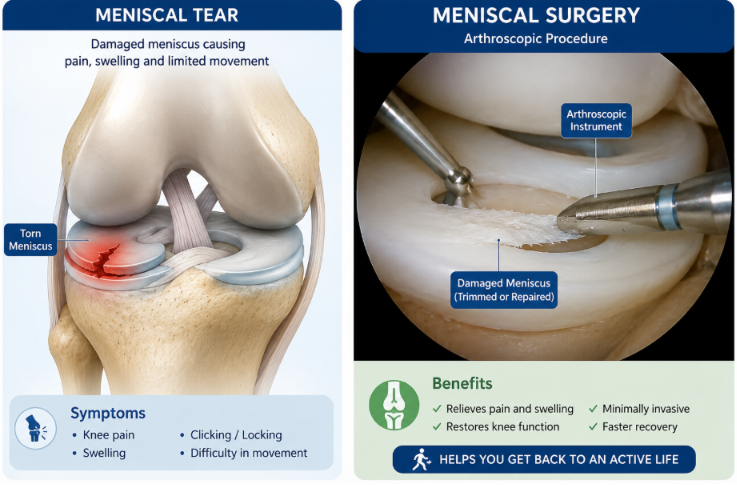
Arthroscopic Meniscus Procedure & Joint Preservation Benefits
Tips for a Faster Recovery After Meniscus Surgery
Successful recovery depends not only on surgery but also on following your rehabilitation programme.
Follow these recommendations:
-
Follow your physiotherapist's exercise programme
-
Use crutches only as advised
-
Avoid twisting movements during early recovery
-
Perform knee strengthening exercises regularly
-
Maintain a healthy body weight
-
Eat a protein-rich diet to support healing
-
Attend scheduled follow-up appointments
-
Return to sports only after medical clearance
Causes and Risk Factors
Primary Causes
- Traumatic Twisting Injuries: Rotating or pivoting forcefully while the foot is planted firmly on the ground (common in football, badminton, cricket, or basketball).
- Deep Squatting & Heavy Lifting: Excessive hyperflexion under load during gym workouts, manual labor, or daily domestic chores.
- Degenerative Tissue Wear: Gradual weakening and thinning of cartilage in adults aged 35+, where a simple misstep or awkward turn causes a complex tear.
Key Risk Factors
- Concomitant Ligament Injuries: Over 50% of acute ACL injuries involve a concomitant meniscal tear.
- High-Impact Sports: Playing on high-friction synthetic turf grounds commonly found across Bangalore.
- Mechanical Alignment: Genu varum (bow-legged alignment) putting disproportionate force on the medial meniscus.
Clinical Diagnosis
Diagnosing a meniscus tear requires differentiating cartilage damage from ligament sprains or patellar conditions.
Focused Physical Examination
- McMurray Test: Rotates the lower leg while flexing and extending the knee to catch and reproduce joint-line clicking or pain.
- Apley’s Grinding Test: Assesses joint-line compression and rotation in the prone position.
- Joint Line Tenderness (JLT): Pinpoint palpation along the medial or lateral knee seam.
Imaging & Diagnostics
High-Resolution MRI Scan: The gold standard imaging tool (1.5T or 3T) to classify tear patterns (horizontal, radial, complex, bucket-handle, ramp, or meniscus root tear).
Weight-Bearing Knee X-Rays: Performed to assess joint space narrowing and rule out underlying osteoarthritis or fractures.
Medical References
The information on this page is based on established orthopaedic principles and international recommendations, including:
- American Academy of Orthopaedic Surgeons (AAOS)
- International Society of Arthroscopy, Knee Surgery and Orthopaedic Sports Medicine (ISAKOS)
- European Society of Sports Traumatology, Knee Surgery and Arthroscopy (ESSKA)
- Arthroscopy: The Journal of Arthroscopic & Related Surgery
- British Journal of Sports Medicine
Non-Surgical Treatment Options
Not all meniscus tears require immediate surgery. Small, asymptomatic tears located on the outer edge of the cartilage can respond well to conservative care.
When Non-Surgical Treatment is Appropriate
- Small (<1 cm) stable tears in the "Red-Red Zone" (the outer 10–30% of the meniscus with direct blood supply).
- Degenerative horizontal tears in older individuals without mechanical locking symptoms.
Initial management includes the R.I.C.E protocol (Rest, Ice, Compression, Elevation), NSAIDs, targeted physical therapy, and platelet-rich plasma (PRP) orthobiologic injections.
Limitations of Conservative Care
A meniscus tear located in the central "White Zone" lacks blood vessels and cannot heal independently. If persistent mechanical symptoms (locking, catching, sharp clicking) continue, surgery becomes necessary to prevent progressive cartilage breakdown.
When Meniscal Surgery is Recommended
Dr. Pradyumna R evaluates several key clinical criteria before recommending keyhole meniscal surgery:
-
Mechanical Joint Locking or Catching: Inability to achieve full extension due to trapped flap tissue.
-
Failure of 6+ Weeks of Physical Therapy: Persistent pain interfering with walking, sports, or daily work.
-
Meniscus Root Tears: Posterior root tears disconnect the entire shock-absorbing function of the meniscus and require urgent surgical re-anchoring to prevent rapid joint decay.
-
Young & Active Patients: Joint-preservation techniques (all-inside repairs) are strongly prioritized to preserve long-term joint health.
-
Combined Ligament Reconstruction: Meniscus tears diagnosed during ACL or PCL reconstruction are repaired simultaneously.
Surgical Procedure Steps (Keyhole Arthroscopy)
1
1. Anesthesia & Patient Preparation: Day-Care Setup
Performed under regional (spinal) anesthesia with a thigh tourniquet applied to ensure complete visual clarity inside the joint.
2
2. Keyhole Portal Access: 4 mm Incisions
Two tiny 4 mm portal incisions are made at the front of the knee to introduce the HD camera lens (arthroscope) and surgical instruments.
3
3. Comprehensive Joint Inspection: Diagnostic Probe
The surgeon visualizes the medial, lateral, and patellofemoral compartments, probing the meniscus to verify tear mobility, location, and tissue quality.
4
4. Surgical Execution: Repair vs. Meniscectomy
Option A (Meniscus Repair): Uses modern all-inside suture repair systems (e.g., FAST-FIX) or inside-out techniques to stitch and stabilize the tear.
Option B (Partial Meniscectomy): Precision trimming of non-repairable, loose, or frayed cartilage edges using micro-shavers and basket forceps while preserving over 80% of stable healthy tissue.
5
5. Joint Washout & Closure: Minimal Scarring
Thorough joint lavage is performed, portal incisions are closed with fine sutures, and a compressive dressing with a protective knee brace is applied.
Risks and Complications
Arthroscopic meniscal surgery is one of the safest orthopaedic procedures, with an overall complication rate of less than 1%:
- Suture Failure / Non-Healing (10–15% in repairs): Dependent on tissue blood supply and post-op compliance; mitigated by using strict post-operative weight-bearing protection.
- Arthrofibrosis (Stiffness): Prevented through early passive range-of-motion physical therapy.
- Infection (<0.2%): Minimised by performing surgeries in ultra-clean laminar flow operating theaters at Manipal Hospitals.
- Post-Meniscectomy Progression: Trimming large portions of cartilage can increase contact stress; Dr. Pradyumna follows a strict tissue-preservation approach.
Recovery Timeline
Recovery speed depends significantly on whether your procedure was a Partial Meniscectomy or a Meniscus Repair:
| Recovery Phase | Partial Meniscectomy | Meniscus Repair (Joint Preservation) |
|---|---|---|
| Weight-Bearing | Immediate full weight-bearing as tolerated (Day 1) | Touch-down weight-bearing with crutches for 4–6 weeks |
| Knee Brace | Usually not required (3–5 days for comfort) | Hinged knee brace locked in extension for 4–6 weeks |
| Flexion Range | Full range of motion permitted immediately | Flexion restricted to 0–90° for first 4 weeks |
| Light Jogging | 3 to 4 weeks post-surgery | 3 to 4 months post-surgery |
| Return to Sports | 4 to 6 weeks post-surgery | 5 to 6 months post-surgery |
Return to Work and Sport
- Desk Jobs: 3 to 7 days for meniscectomy; 10 to 14 days for meniscus repair.
- Active / Field Jobs: 2 to 4 weeks for meniscectomy; 8 to 12 weeks for repair.
- Driving: 1 to 2 weeks for left leg (automatic car); 3 to 5 weeks for right leg or manual transmission once emergency braking reaction time is restored.
- High-Impact Sports (Football, Badminton, Running): 4 to 6 weeks after meniscectomy; 5 to 6 months after repair upon passing functional hop and quad strength clearance tests.
Cost Factors of Meniscal Surgery in Bangalore
- Procedure Type: Meniscus repair using specialized imported all-inside suture anchors involves material costs compared to simple meniscectomy trimming.
- Hospital Stay & Room Category: Day-care vs. 24-hour admission at tertiary centers like Manipal Hospitals.
- Concurrent Procedures: Simultaneous ACL reconstruction or cartilage microfracture.
- Insurance Coverage: Meniscal surgery is a standard medically indicated procedure covered under health insurance plans with full cashless TPA assistance.
Key Takeaways
-
Preserve the Meniscus Whenever Possible: Dr. Pradyumna prioritizes meniscus repair over removal to protect your natural shock absorber and prevent early joint arthritis.
-
Locking Requires Early Evaluation: A flex-locked knee from a bucket-handle tear needs quick keyhole intervention to prevent permanent cartilage damage.
-
Rehab Differs Dramatically: Meniscectomy allows rapid walking within days, whereas repair requires 4–6 weeks of protected weight-bearing to allow biological suture healing.
-
Keyhole Precision: Performed through tiny 4 mm portals with minimal scarring, low pain, and fast recovery.
Author & Reviewer Profile

Dr. Pradyumna R, MBBS, MS (Orthopaedics)
- Qualifications: Fellowship in Arthroscopy & Sports Medicine (ISAKOS), International Fellowship in Shoulder & Elbow Surgery (TU Munich, Germany), FIFA Diploma in Football Medicine
- Experience: 15+ Years Clinical Expertise | 2,000+ Keyhole Knee Arthroscopies & Meniscal Repairs
- Clinical Practice: Senior Arthroscopy Specialist at Bangalore Orthopaedic Clinic (BTM Layout 2nd Stage) & Visiting Consultant at Manipal Hospitals (Kanakapura Road & Jayanagar)
- Last Reviewed Date: July 2026
- Profile Link: Dr. Pradyumna R Clinical Profile & Qualifications
Frequently Asked Questions
1. Who is the best meniscal surgeon in Bangalore?
Dr. Pradyumna R is considered a leading meniscal repair specialist in Bangalore. With fellowship training in Germany and over 2,000 keyhole knee procedures, he specializes in advanced all-inside meniscus preservation at Bangalore Orthopaedic Clinic (BTM Layout) and Manipal Hospitals.
2. Is meniscus repair better than removing the torn meniscus (meniscectomy)?
Yes, repairing the meniscus is far superior for long-term knee health. Preserving natural meniscus cartilage protects the joint from friction, keeping long-term arthritis risk much lower compared to removing cartilage.
3. Can a torn meniscus heal without surgery?
Tears located in the outer "Red Zone" with good blood supply can heal with rest, physical therapy, and orthobiologics. However, inner "White Zone" tears or complex mechanical bucket-handle tears cannot heal naturally and usually require arthroscopic intervention.
4. How much does meniscal surgery cost in Bangalore?
Cost varies depending on whether you undergo a partial meniscectomy or a complex all-inside meniscus repair requiring specialized suture implants. Hospital room choice and insurance coverage also impact final costs. Contact Dr. Pradyumna’s clinic for a transparent cost estimate.
5. How long does it take to walk normally after meniscal surgery?
After a Partial Meniscectomy, most patients walk comfortably within 3 to 7 days. After a Meniscus Repair, patients use crutches and a brace for 4 to 6 weeks to protect the healing suture line before transitioning to normal unassisted walking.
6. Is keyhole meniscal surgery painful?
Post-operative pain is minimal to moderate because the procedure uses tiny 4 mm keyhole portal incisions and intra-operative nerve blocks. Any mild soreness is controlled with standard oral pain medications for a few days.
7. What is a bucket-handle meniscus tear?
A bucket-handle tear is a large longitudinal tear where the inner torn segment flips into the center of the knee joint. This causes classic "knee locking" where the leg physically cannot be straightened and requires prompt keyhole repair.
8. What is a meniscus root tear?
A meniscus root tear occurs when the posterior attachment anchor of the meniscus tears off the shin bone. This completely destroys the meniscus's ability to absorb load, acting like a total loss of the meniscus unless surgically re-anchored.
9. Can I climb stairs after meniscus surgery?
After meniscectomy, stair climbing is usually resumed within 1 to 2 weeks. After meniscus repair, stair climbing is restricted or done strictly with crutches for the first 4 weeks to avoid putting high shearing force on the repair.
10. Will health insurance cover meniscal surgery in Bangalore?
Yes, arthroscopic meniscal repair and meniscectomy are standard, medically necessary orthopaedic procedures covered by major health insurance policies and corporate TPA cashless networks.
11. What happens if I ignore a meniscus tear?
Ignoring an unstable tear can cause the torn flap to grind continuously against the smooth joint cartilage. Over time, this leads to deep cartilage ulcers, chronic joint swelling, secondary meniscal damage, and early-onset knee osteoarthritis.
12. How long does keyhole meniscus surgery take in the operating room?
The keyhole procedure typically takes 30 to 60 minutes, depending on whether it is a simple trimming or a multi-suture repair.
13. When can I return to sports like football or badminton after meniscus surgery?
Return to high-impact pivoting sports occurs in 4 to 6 weeks after partial meniscectomy, and 5 to 6 months after meniscus repair following dynamic balance and quad strength testing.
14. What is an "All-Inside" meniscus repair?
An "All-Inside" repair uses specialized flexible micro-instruments and tiny bio-compatible suture anchors inserted entirely through keyhole portals. This eliminates the need for extra open skin incisions behind the knee, reducing nerve risk and recovery pain.
15. Where does Dr. Pradyumna R consult and perform meniscal surgeries in Bangalore?
Dr. Pradyumna provides outpatient consultations and MRI evaluations at Bangalore Orthopaedic Clinic in BTM Layout 2nd Stage. Surgeries are performed in state-of-the-art laminar flow operating theatres at Manipal Hospitals (Kanakapura Road & Jayanagar).
Advanced Orthopaedic Care
Trusted Orthopaedic Expertise
Patient Trust
Clinical Experience
15+ Years Experience20,000+ Happy Patients | Fellowship Trained at TUM, Germany
Surgical Volume
Surgical Track Record
5,000+ Surgeries PerformedKnee & Shoulder Arthroscopy | Joint Replacement | Trauma & Robotic Surgery
Awards
Recognized for Excellence
Outlook Award Winner 2024 & 2025Best Orthopedic & Joint Replacement Surgeon - South India