

Knee replacement surgery has evolved significantly over the last two decades. What was once a highly manual, surgeon-dependent procedure has now entered an era of data-driven precision through robotic-assisted knee replacement. This advancement has transformed outcomes for patients suffering from severe knee arthritis, deformities, and long-standing joint damage.
Robotic technology does not replace the surgeon - it enhances the surgeon's expertise, enabling unmatched accuracy, customization, and consistency. This article explains what robotic knee replacement is, how it is performed, how it compares to conventional techniques, recovery expectations, and who is best suited for this advanced procedure.
What Is Robotic-Assisted Knee Replacement?
Robotic-assisted knee replacement is an advanced surgical technique where a computer-guided robotic system assists the surgeon in planning and executing the procedure with extreme precision. It is one of the advanced options within total knee replacement surgery.
Before surgery, detailed imaging (CT scan or 3D mapping) of the patient's knee is used to create a personalized virtual model of the joint. This allows the surgeon to plan:
- Exact bone cuts
- Ideal implant size and alignment
- Soft-tissue balance
- Optimal positioning based on the patient's anatomy
During surgery, the robotic system provides real-time feedback and guidance, ensuring bone preparation and implant placement match the pre-planned strategy within millimeter accuracy.
How Is Robotic Knee Replacement Performed?
Robotic knee replacement follows a structured, highly controlled process:
1. Pre-operative Planning
A 3D model of the knee is created using imaging data. This allows the surgeon to simulate the surgery even before entering the operating room.
2. Intra-operative Mapping
During surgery, the robotic system maps the knee in real time, accounting for ligament tension, movement, and alignment.
3. Precision Bone Preparation
The robot assists the surgeon in making highly accurate bone cuts, preventing deviation beyond the planned boundaries. This reduces unnecessary bone removal.
4. Implant Placement
The knee implant is placed in the exact planned position, ensuring optimal alignment and joint balance.
5. Surgeon Control at Every Step
Importantly, the robot never operates independently. The surgeon remains in full control throughout the procedure, using the robot as a precision tool.
.jpeg)
How Robotic Knee Replacement Is Superior to Conventional Techniques
Traditional knee replacement relies heavily on manual instruments and visual estimation, which can introduce variability. Robotic assistance addresses these limitations.
1. Superior Accuracy and Alignment
Even small alignment errors in knee replacement can lead to early implant wear or persistent pain. Robotic systems improve accuracy dramatically, resulting in:
- Better limb alignment
- Improved joint mechanics
- Longer implant lifespan
2. Personalized Surgery
Every knee is anatomically different. Robotic surgery allows patient-specific customization, rather than a “one-size-fits-all" approach.
3. Better Soft-Tissue Balance
Real-time feedback allows the surgeon to fine-tune ligament tension, leading to:
- More natural knee movement
- Reduced stiffness
- Improved stability
4. Reduced Surgical Trauma
Precise bone cuts and controlled movements mean less damage to surrounding tissues, resulting in:
- Reduced blood loss
- Lower post-operative pain
- Faster functional recovery
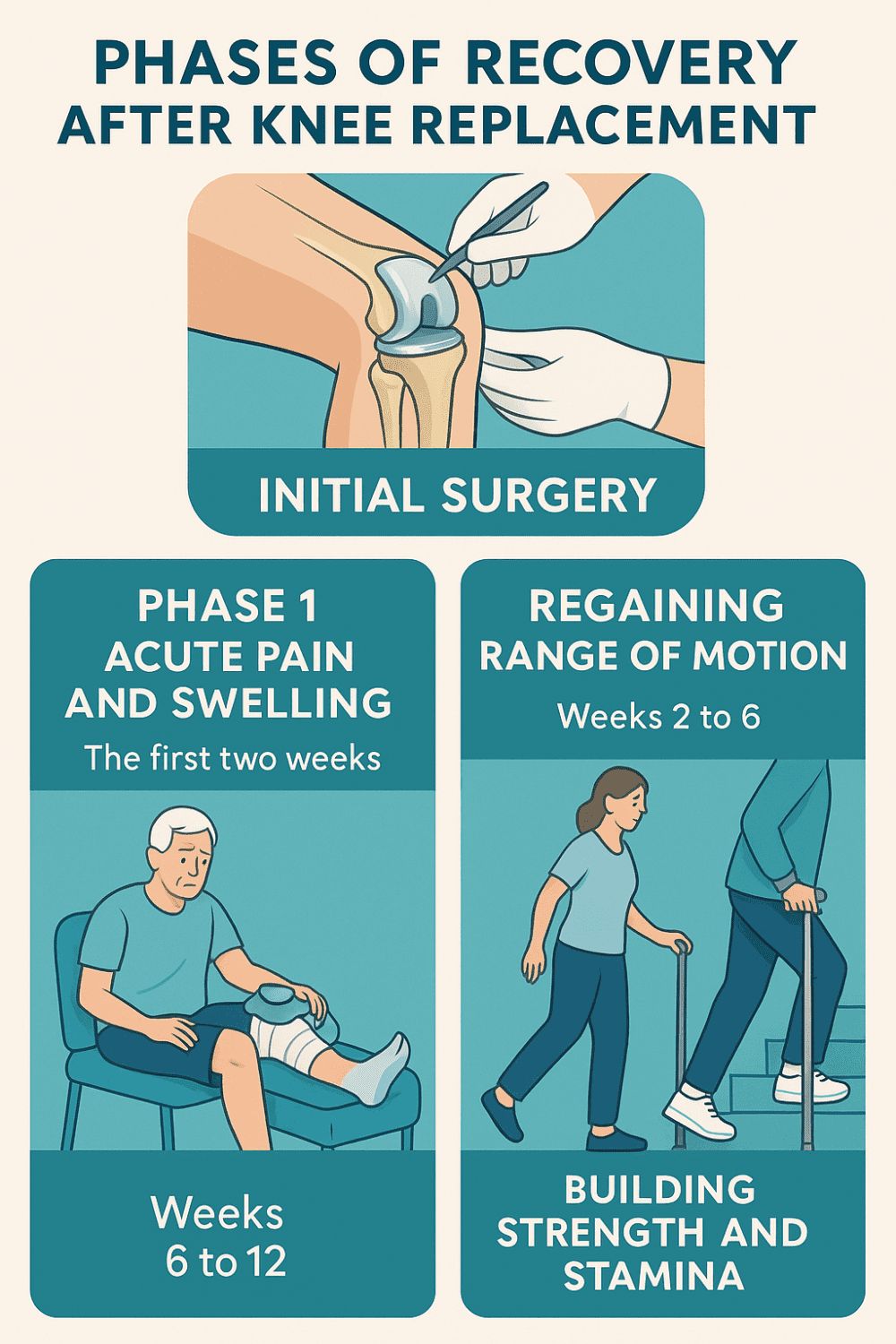
Recovery Timeline: Robotic vs Traditional Knee Replacement
One of the most significant advantages of robotic-assisted knee replacement is enhanced recovery.
Typical Recovery Milestones (Robotic-Assisted)
- Day 1 - 2: Standing and walking with support
- 1 - 2 Weeks: Reduced pain, improved knee bending
- 3 - 4 Weeks: Walking with minimal or no support
- 6 Weeks: Return to most daily activities
- 3 Months: Near-normal function for most patients
Compared to Conventional Knee Replacement
Patients undergoing robotic surgery often experience:
- Less post-operative pain
- Reduced need for strong pain medications
- Shorter hospital stay
- Faster return to independence
- Better early knee function
While long-term outcomes are excellent in both methods, robotic surgery offers a smoother, more predictable recovery journey.
Who Is an Ideal Candidate for Robotic Knee Replacement?
Robotic-assisted knee replacement is suitable for a wide range of patients, including:
- Individuals with advanced knee arthritis
- Patients with knee deformities (bow-legged or knock-knee)
- Active individuals seeking long-lasting results
- Patients who want quicker recovery and better knee function
Age Considerations
There is no strict age limit. Both younger, active patients and older individuals can benefit. The decision depends more on bone quality, lifestyle, and severity of joint damage rather than age alone.
Why Surgical Expertise Still Matters
While robotic technology enhances precision, outcomes ultimately depend on the surgeon's skill and experience. Choosing a surgeon trained in robotic systems and knee reconstruction is crucial for maximizing benefits.
Surgeons experienced in both traditional and robotic techniques can make the right judgment for each patient, tailoring surgery to individual needs.
Take the Next Step Toward Pain-Free Movement
If knee pain is limiting your mobility, quality of life, or independence, robotic-assisted knee replacement may offer a long-term, reliable solution.
📞 Consult with Dr. Pradyumna R, an experienced orthopedic surgeon specializing in advanced knee replacement techniques.
Book a consultation today to:
- Understand if robotic knee replacement is right for you
- Explore personalized treatment options
- Begin your journey toward confident, pain-free movement
The Benefits of Robotic-Assisted Knee Replacement
FAQ's
1. Is robotic knee replacement better than traditional knee replacement?
Robotic knee replacement offers higher precision, better implant alignment, and often faster recovery compared to traditional surgery.
2. How long does it take to recover from robotic knee replacement?
Most patients resume normal daily activities within 4 to 6 weeks, with full recovery in about 3 months.
3. Is robotic knee replacement painful?
Patients usually experience less post-surgery pain because the procedure is more precise and less invasive to surrounding tissues.
4. How long does a robotic knee replacement last?
A well-performed robotic knee replacement can last 15 to 20 years or more depending on lifestyle and care.
5. Who is eligible for robotic knee replacement surgery?
Patients with severe knee arthritis, chronic knee pain, or joint damage that affects daily life may be eligible for this procedure.
6. Does the robot perform the knee replacement surgery?
No. The surgeon remains in full control throughout the procedure. The robotic system assists with planning, alignment, bone preparation, and precision guidance.
7. Is robotic knee replacement suitable for knee deformity?
Robotic planning can be useful for patients with bow-leg or knock-knee deformity because it helps the surgeon plan implant alignment and soft-tissue balance more accurately.
8. Will robotic knee replacement reduce hospital stay?
Many patients experience smoother early recovery and may have a shorter hospital stay, depending on age, medical fitness, pain control, and physiotherapy progress.
9. Is physiotherapy needed after robotic knee replacement?
Yes. Physiotherapy is essential after surgery to restore knee bending, walking confidence, muscle strength, balance, and daily function.
10. How do I know if robotic knee replacement is right for me?
A clinical examination, X-rays, functional assessment, and discussion of your pain, mobility, and lifestyle goals help determine whether robotic knee replacement is appropriate.