
By Dr. Pradyumna R | Consultant Orthopaedic Surgeon | Knee & Shoulder Surgery | Sports Medicine | Arthroscopy | Joint Replacement | Bangalore
You twist your knee while playing badminton, land awkwardly after a jump, or slip while walking. There is sudden pain, perhaps a popping sensation, and soon your knee begins to swell. Your first thought may be: Have I torn a ligament? And if so, which one?
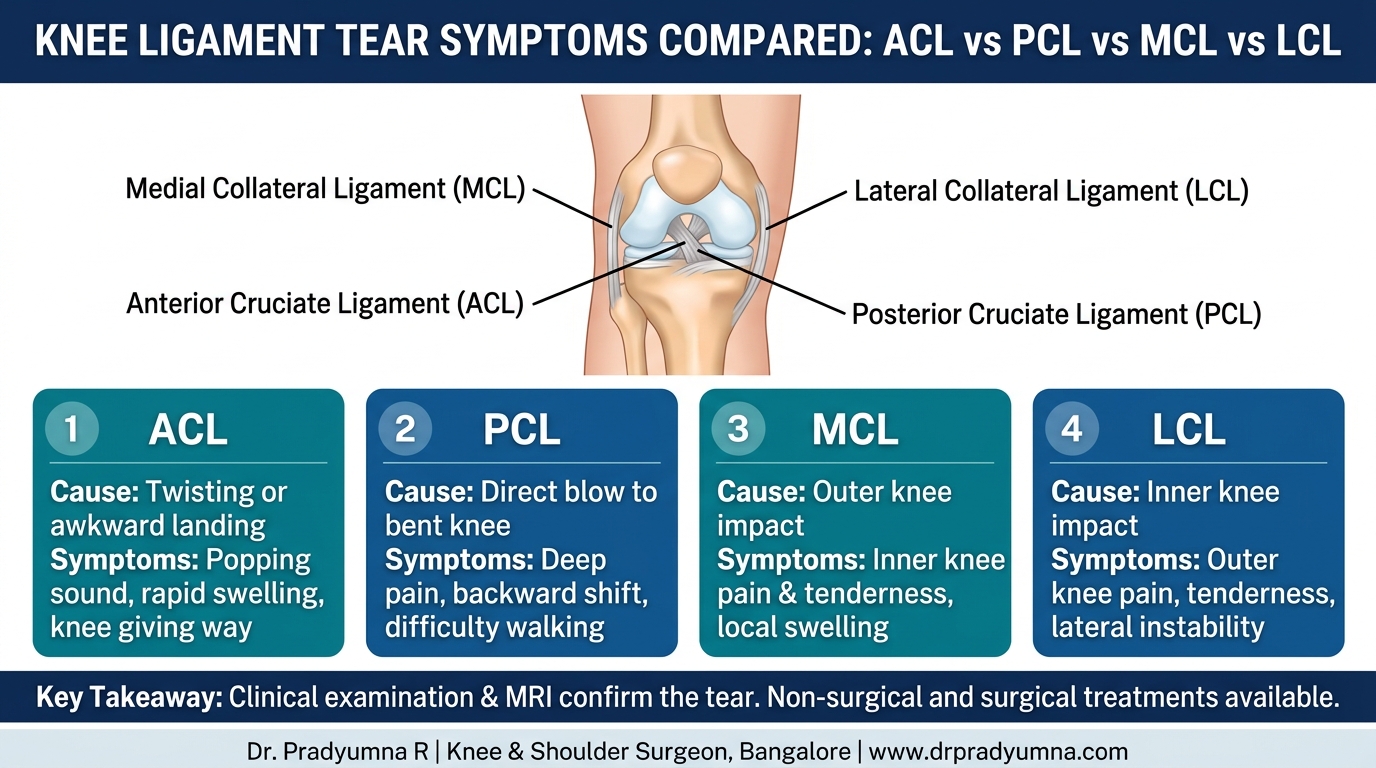
The knee has four major ligaments: ACL, PCL, MCL and LCL. Each helps stabilise the joint, but they are injured in different ways. Understanding the symptoms can give you an idea of what may have happened.
The simplest way to distinguish them is:
-
ACL tear: Often follows twisting or sudden changes in direction, with a possible pop, swelling and knee instability.
-
PCL tear: Commonly follows a forceful impact to a bent knee, causing pain, swelling and difficulty walking.
-
MCL tear: Usually causes pain and tenderness on the inner side of the knee.
-
LCL tear: Usually causes pain and tenderness on the outer side of the knee.
These are clues, not a diagnosis. Different knee injuries can produce similar symptoms, and more than one structure may be damaged. If you are looking for information on knee ligament tear symptoms in Bangalore, this guide explains what to look for, when to seek help and how an orthopaedic surgeon confirms the injury.
Understanding the Four Main Ligaments of Your Knee
Ligaments are strong bands of tissue connecting bones. They help keep the knee stable when you walk, climb stairs, run, turn or change direction. Your knee has four main stabilising ligaments.
1. Anterior Cruciate Ligament (ACL)
The ACL lies inside the knee. It helps prevent the shin bone from moving too far forward and provides rotational stability when you turn or pivot.
2. Posterior Cruciate Ligament (PCL)
The PCL is also inside the knee, behind the ACL. It prevents the shin bone from moving too far backward.
3. Medial Collateral Ligament (MCL)
The MCL runs along the inner side of the knee. It protects the joint against excessive sideways movement.
4. Lateral Collateral Ligament (LCL)
The LCL is on the outer side of the knee. It helps resist forces that push the knee outward.
Although all four ligaments provide stability, the location of pain, type of injury and pattern of swelling may help identify which ligament is affected.
ACL vs PCL vs MCL vs LCL: Knee Ligament Tear Symptoms at a Glance
| Ligament | Common cause of injury | Typical symptoms |
|---|---|---|
| ACL | Sudden twisting, pivoting or awkward landing | Pop, rapid swelling, knee giving way |
| PCL | Direct impact to a bent knee or forceful fall | Deep knee pain, swelling, difficulty walking |
| MCL | Impact to the outside of the knee or sideways stress | Inner knee pain, tenderness, local swelling |
| LCL | Impact to the inside of the knee or outward bending force | Outer knee pain, tenderness, instability |
Important: Pain location alone cannot confirm a ligament tear. Meniscus tears, fractures and other knee injuries can cause overlapping symptoms.
1. ACL Tear Symptoms: When Your Knee Feels Unstable
The anterior cruciate ligament (ACL) is frequently injured during sports involving sudden stops, jumping and changes in direction. Football, basketball and badminton are common examples. An ACL injury can also happen during a fall or awkward movement in everyday life.
Common symptoms of an ACL tear
-
A popping sound or sensation at the time of injury
-
Swelling developing within the first few hours, sometimes later
-
Sudden pain that makes continuing an activity difficult
-
A feeling that the knee is slipping, shifting or giving way
-
Difficulty fully bending or straightening the knee
-
Instability while turning, changing direction or using stairs
One feature worth paying attention to is instability after the initial pain settles. Some people with an ACL tear find that they can walk once the swelling reduces. However, the knee may unexpectedly give way when they turn or change direction. This happens because the injured ACL can no longer provide its usual stability.
When to suspect an ACL injury: Your knee twisted during an activity, swelled soon afterwards, and now feels unreliable when you turn.
A suspected ACL tear requires clinical examination. Some patients recover well with rehabilitation, while others may need ACL reconstruction surgery in Bangalore, depending on their knee stability, activity requirements and associated injuries.
2. PCL Tear Symptoms: An Injury That Can Be Less Obvious
The posterior cruciate ligament (PCL) is stronger than the ACL, and PCL injuries are less common. A typical cause is a strong impact to the front of the shin while the knee is bent. For example:
-
The knee strikes the dashboard during a road accident.
-
Someone falls directly onto a bent knee.
-
A player experiences a forceful impact during contact sports.
Common symptoms of a PCL tear
-
Pain deep within the knee, sometimes towards the back
-
Swelling and stiffness following the injury
-
Difficulty walking comfortably
-
Pain or discomfort when using stairs
-
A feeling of weakness or instability
-
Reduced knee movement
A PCL tear may not always produce the dramatic popping sensation people associate with an ACL injury. Some isolated PCL injuries cause relatively mild symptoms, making them easier to overlook.
When to suspect a PCL injury: You experienced a direct impact to a bent knee, followed by swelling, discomfort or instability.
An orthopaedic examination can identify abnormal backward movement of the shin bone. An MRI may be recommended to evaluate the ligament and check for associated injuries. Learn more about PCL reconstruction and treatment in Bangalore.
3. MCL Tear Symptoms: Pain on the Inner Side of the Knee
The medial collateral ligament (MCL) runs along the inner side of the knee. It is often injured when a force pushes the knee inward, stretching the ligament on the opposite side. This may happen during a sports collision, awkward fall or sudden sideways movement.
Common symptoms of an MCL tear
-
Pain along the inner side of the knee
-
Tenderness when touching the injured area
-
Swelling around the inner knee
-
Bruising in some cases
-
Pain when the knee is stressed sideways
-
A feeling of looseness or instability in more severe injuries
Unlike an ACL tear, an isolated MCL injury may cause more localised tenderness along the ligament rather than marked swelling throughout the joint.
When to suspect an MCL injury: Your knee was pushed inward during an injury, and the strongest pain is along its inner side.
The encouraging news is that many isolated MCL injuries heal without surgery. Depending on the severity, treatment may involve a hinged knee brace, activity modification and physiotherapy. However, a severe MCL tear or an injury involving the ACL or other structures needs a more detailed treatment plan, including MCL reconstruction if required.
4. LCL Tear Symptoms: Pain on the Outer Side of the Knee
The lateral collateral ligament (LCL) is located on the outer side of the knee. LCL injuries are less common than MCL injuries and can occur when a force pushes the knee outward. They may also result from forceful twisting or hyperextension.
Common symptoms of an LCL tear
-
Pain along the outer side of the knee
-
Tenderness when pressing the outside of the joint
-
Swelling or bruising around the injured area
-
Difficulty walking or changing direction
-
A feeling that the knee is unstable
-
Pain when the knee is placed under sideways stress
When to suspect an LCL injury: You experience outer knee pain and instability after a sideways impact or twisting injury.
LCL injuries deserve careful assessment because they can occur alongside damage to other structures that stabilise the outer and back portions of the knee. Severe injuries may also affect the nearby peroneal nerve. New numbness, tingling or difficulty lifting the foot after a knee injury requires urgent medical assessment. Explore LCL reconstruction surgery options.
Can You Tell Which Knee Ligament Is Torn Just by Where It Hurts?
Pain location provides a useful starting point, but it is not enough to diagnose a ligament tear. For example:
-
Pain on the inner side may suggest an MCL injury, but a medial meniscus tear can cause similar pain.
-
Pain on the outer side may suggest an LCL injury, but the lateral meniscus and other structures can also be responsible.
-
Pain deep inside the knee may occur with ACL, PCL or meniscus injuries.
-
Pain accompanied by rapid swelling may indicate significant internal joint damage.
The way the injury occurred is often as important as the location of the pain. An orthopaedic surgeon evaluates both.
How Serious Is a Knee Ligament Tear?
Knee ligament injuries are commonly classified into three grades.
Grade 1 – Mild sprain
The ligament is stretched or has minor fibre damage. The knee generally remains stable.
Grade 2 – Partial tear
Some ligament fibres are torn. Pain, swelling and a degree of joint looseness may be present.
Grade 3 – Complete tear
The ligament is completely disrupted. This may cause significant instability, although symptoms vary between patients and ligaments.
A Grade 3 injury does not automatically mean surgery is necessary. Treatment depends on the ligament involved, knee stability, associated damage and the patient’s activity needs.
How Does an Orthopaedic Surgeon Diagnose a Knee Ligament Tear?
A diagnosis begins by understanding how the injury happened. At Bangalore Orthopaedic Clinic, the clinical evaluation focuses on identifying the injured structures and determining how stable the knee remains.
Step 1: Understanding the injury
The surgeon may ask:
-
Did the knee twist or receive a direct blow?
-
Was there a popping sensation?
-
How quickly did the swelling develop?
-
Could you continue walking immediately after the injury?
-
Does your knee give way during everyday activities?
These details help narrow down the possible injuries.
Step 2: Physical examination
Specific clinical tests help assess the knee ligaments.
| Clinical test | Main ligament assessed |
|---|---|
| Lachman test | ACL |
| Posterior drawer test | PCL |
| Valgus stress test | MCL |
| Varus stress test | LCL |
These tests should be performed by a trained clinician, not attempted at home on an injured knee.
Step 3: Imaging, when needed
X-rays help identify fractures or bone injuries associated with trauma. They do not directly show most ligament tears.
MRI scans provide detailed images of the ligaments, menisci, cartilage and other soft tissues. They can help confirm the extent of damage and identify multiple injuries.
Not every knee injury requires an immediate MRI. The need for imaging is determined by the examination and suspected injury.
Can a Knee Ligament Tear Heal Without Surgery?
Yes. Not all ligament tears require an operation. Some isolated MCL and PCL injuries can be managed successfully with rehabilitation and appropriate bracing. Certain stable, lower-grade LCL injuries may also heal without surgery.
For ACL tears, the decision is more individual. Factors such as repeated instability, sporting requirements, associated meniscus injuries and the patient’s functional goals influence treatment.
When surgery is indicated, knee arthroscopy and ligament reconstruction may form part of the treatment. The priority is not simply whether a ligament is torn. It is whether the knee can function safely and reliably after treatment.
What Should You Do Immediately After a Suspected Knee Ligament Injury?
Until the injury is assessed:
-
1. Protect the knee: Stop the activity that caused the injury and avoid twisting or pivoting.
-
2. Reduce weight-bearing if painful: Use assistance or crutches if needed.
-
3. Apply ice: Use a cold pack wrapped in a towel for 15–20 minutes at a time.
-
4. Use gentle compression: A supportive bandage may help control swelling, provided it does not restrict circulation.
-
5. Elevate the leg: Keep the knee supported while resting.
Do not attempt to test the knee by repeatedly twisting it, forcing it to bend or trying to return to sports immediately.
Seek emergency care if the knee looks deformed, the foot becomes cold or pale, there is new loss of sensation or foot movement, or the injury involves major trauma. Severe swelling, inability to bear weight or a locked knee also warrant urgent medical assessment.
Frequently Asked Questions About Knee Ligament Tears
1. How do I know which ligament I tore in my knee?
The symptoms and mechanism of injury offer clues. ACL injuries often cause swelling and instability after twisting. PCL injuries may follow an impact to a bent knee. MCL tears usually cause inner knee pain, while LCL tears commonly cause outer knee pain. However, only a clinical examination, supported by imaging when necessary, can reliably identify the injured ligament.
2. What are the symptoms of a torn ACL?
Common ACL tear symptoms include a popping sensation, knee swelling, pain, difficulty continuing an activity and a feeling that the knee is giving way. Instability is particularly noticeable during turning, pivoting or sudden changes in direction.
3. What are the symptoms of a torn PCL?
A PCL tear may cause deep knee pain, swelling, stiffness, difficulty walking and instability. It often follows a direct impact to the front of a bent knee, such as during a road accident or fall. Symptoms may sometimes be mild, particularly with an isolated injury.
4. What does a torn MCL feel like, and where does it hurt?
An MCL tear typically causes pain and tenderness along the inner side of the knee. There may be local swelling, bruising or discomfort when the knee is stressed sideways. More severe tears can make the knee feel loose or unstable.
5. What are the signs of an LCL tear?
An LCL tear usually causes pain, swelling or tenderness along the outer side of the knee. Some patients experience instability when walking or turning. Severe outer-knee injuries may involve other ligaments or nearby nerves and should be assessed promptly.
6. Does a torn knee ligament always make a popping sound?
No. A popping sound is common with certain ACL injuries but is not present in every ligament tear. MCL, PCL and LCL injuries may occur without an obvious pop. Similarly, hearing a pop does not necessarily mean that a ligament is torn. The overall injury pattern matters more than any single symptom.
7. Can I walk with a torn ligament in my knee?
Yes. Some people can walk even with a significant ligament injury. The ability to walk depends on the ligament involved, severity of the tear, associated injuries and degree of pain. Being able to walk does not rule out an ACL, PCL, MCL or LCL tear. Avoid sports or movements that make the knee unstable until it has been assessed.
8. Why does my knee feel like it is giving way after an injury?
A giving-way sensation can occur when an injured ligament is no longer providing adequate joint stability. However, pain, muscle weakness and meniscus injuries can also contribute. Repeated instability should not be ignored because further giving-way episodes may damage other knee structures.
9. Can more than one knee ligament be torn at the same time?
Yes. A severe knee injury can damage two or more ligaments. For example, an ACL injury may occur alongside an MCL or meniscus tear. High-energy injuries can involve multiple ligaments and, occasionally, nerves or blood vessels. Suspected multi-ligament injuries require prompt specialist evaluation because they may need more complex treatment.
10. When should I see a doctor for a suspected knee ligament tear, and how is it diagnosed?
Arrange an early orthopaedic assessment if your knee swells after an injury, repeatedly gives way, remains painful or becomes difficult to move. The surgeon will review the injury history, examine knee stability and recommend X-rays or MRI scans when appropriate. Seek urgent care immediately for severe trauma, visible deformity, circulation changes, new numbness or major difficulty moving or bearing weight.