One of the first questions patients ask after ACL reconstruction is, “When will I be able to walk normally again?” For some, the immediate concern is returning to an office job. For others, it is navigating Bangalore traffic, riding a two-wheeler or getting back to weekend cricket, badminton or football. The answer depends on more than how quickly the surgical wounds heal. ACL surgery recovery generally takes 9–12 months before returning to demanding sports, although walking, working and most routine activities resume much earlier. Understanding the ACL surgery recovery time in Bangalore can help patients plan rehabilitation, manage expectations and avoid returning to strenuous activities before their knee is ready.
Why Does ACL Recovery Take So Long?
ACL reconstruction replaces the torn ligament with a tendon graft. Although the graft is secured during surgery, it requires time to undergo biological healing and adaptation. Meanwhile, the surrounding muscles must regain strength, balance and coordination. Recovery depends on several factors, including:
-
The type of graft used during reconstruction
-
Associated meniscus or cartilage injuries
-
Muscle strength and knee movement before surgery
-
Consistency with physiotherapy
-
Individual healing and functional progress
When meniscus repair or additional ligament surgery is performed, rehabilitation may require extra precautions. Rather than following the calendar alone, successful rehabilitation progresses through measurable milestones.
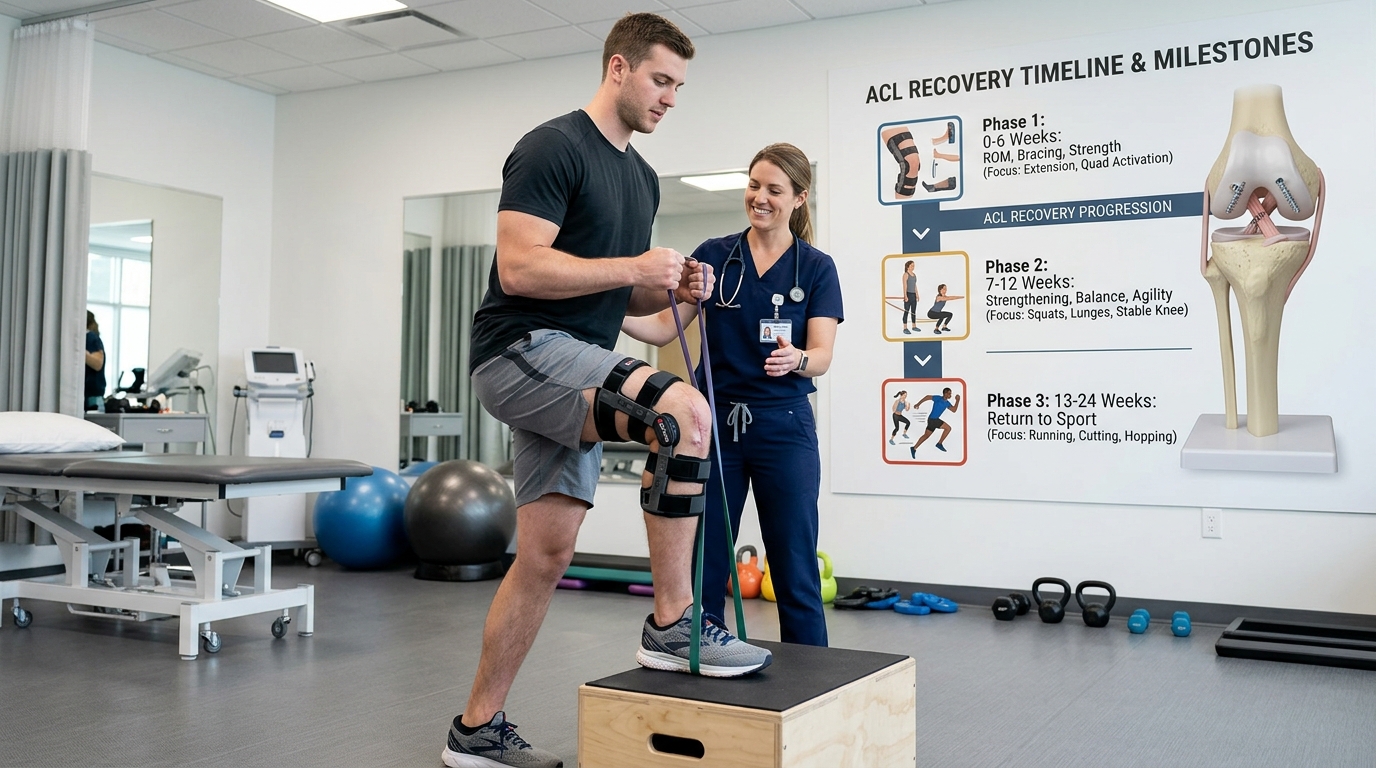
ACL Reconstruction Recovery Timeline: Week by Week
Week 1: Managing Pain, Swelling and Early Movement
The first week focuses on protecting the operated knee while beginning controlled movement. Swelling, discomfort and difficulty bending the knee are common. Patients generally begin walking with crutches according to their surgeon’s instructions. Early exercises focus on restoring knee extension, activating the quadriceps and improving circulation. Ice application, leg elevation and prescribed medication help manage postoperative discomfort.
The main goal: Reduce swelling, regain muscle activation and begin safe mobility.
Weeks 2–4: Improving Walking and Knee Movement
During this stage, patients usually notice gradual improvements in comfort and movement. Physiotherapy focuses on restoring knee range of motion, improving walking patterns and strengthening the muscles supporting the joint. Some patients can begin reducing their dependence on crutches, provided they have adequate quadriceps control and can walk without significant limping. Patients who have undergone meniscus repair may need to follow a more restricted weight-bearing programme.
The main goal: Improve mobility while maintaining graft protection.
Weeks 5–6: Building Strength and Confidence
By this stage, many patients undergoing uncomplicated ACL reconstruction can walk more comfortably without crutches. Rehabilitation may include stationary cycling, controlled strengthening, balance exercises and functional movement training. Knee swelling should generally be improving, although mild swelling after increased activity can still occur.
The main goal: Restore comfortable walking and improve muscular control.
Weeks 7–12: Strengthening and Functional Recovery
As mobility improves, rehabilitation becomes more demanding. Exercises increasingly target quadriceps strength, hamstring control, balance and coordinated lower-limb movement. Patients may feel considerably better during everyday activities. However, the graft is still undergoing biological adaptation, and feeling comfortable does not mean it is ready for twisting or sporting loads.
The main goal: Build a stronger foundation for advanced rehabilitation.
Months 3–4: Preparing for Running
Some patients become ready to begin a supervised, straight-line jogging programme around this stage. Before running, the knee should have good movement, minimal swelling, adequate strength and controlled single-leg function. Running is introduced gradually rather than through immediate long-distance training.
The main goal: Progress towards impact activity without provoking pain or swelling.
Months 4–6: Advanced Strengthening
This phase introduces increasingly challenging exercises, which may include supervised hopping, landing drills and controlled agility training when appropriate. The physiotherapist evaluates movement quality, leg strength and confidence. Patients returning to sports involving sudden changes of direction need particular attention to landing mechanics and rotational control.
The main goal: Improve strength, endurance and movement control.
Months 6–9: Sport-Specific Training
Rehabilitation becomes more closely related to the patient’s sporting goals. For example, a badminton player may practise controlled footwork, while a footballer may gradually progress through running and directional drills. These activities are introduced in stages and do not automatically mean the patient is ready for competitive matches.
The main goal: Demonstrate safe movement under increasingly demanding conditions.
Months 9–12 and Beyond: Returning to Sport
Many patients may be considered for a return to pivoting sports during this period. However, clearance depends on more than elapsed time. The surgeon and physiotherapist assess muscle strength, knee stability, hop performance, movement mechanics and psychological readiness. Some athletes require longer rehabilitation, particularly following complex injuries.
The main goal: Return to the desired sport with an appropriately rehabilitated, stable knee.
Why Rehabilitation Matters in Bangalore
For patients in Bangalore, recovery planning should consider daily routines. Long commutes, crowded public transport, prolonged sitting and frequent stops in traffic may increase discomfort during early recovery. Working from home temporarily, arranging alternative transport and choosing a conveniently located physiotherapy centre can make rehabilitation more manageable. Consistency matters more than rushing through exercises.
10 Frequently Asked Questions About ACL Surgery Recovery
1. How long does it take to recover from ACL surgery in Bangalore?
Most patients gradually resume routine activities within several weeks to months. More demanding sports typically require approximately 9–12 months or longer. Recovery varies depending on associated injuries, rehabilitation progress and individual functional milestones.
2. When can I walk without crutches after ACL reconstruction?
Many patients can begin walking without crutches within approximately 2–4 weeks, although some progress earlier or later. Crutches should be discontinued only when walking is controlled, without significant limping, and the surgeon or physiotherapist permits it. Meniscus repair can extend this period.
3. When can I start physiotherapy after ACL surgery, and where can I do it in Bangalore?
Physiotherapy usually begins on the day of surgery or shortly afterwards with safe, guided exercises. Patients in Bangalore can attend a sports physiotherapy or orthopaedic rehabilitation centre convenient to their home or workplace. Ideally, the physiotherapist should coordinate with the operating surgeon and follow the prescribed rehabilitation protocol.
4. When can I drive after ACL reconstruction (car vs two-wheeler in Bangalore traffic)?
Driving depends on the operated leg, transmission type and ability to brake safely. For automatic cars, driving may be possible around 2–3 weeks after left-sided surgery and 4–6 weeks after right-sided surgery. Manual cars may require 4–6 weeks or longer. Two-wheelers require additional balance, weight-bearing and emergency-control abilities. There is no universal safe timeline. Bangalore’s stop-and-go traffic makes individual clearance particularly important.
5. When can I return to work after ACL surgery (IT/desk job vs field or physical job)?
Patients with desk-based or IT jobs may return within approximately 2–4 weeks, sometimes earlier with suitable work-from-home arrangements. Jobs involving frequent standing, lifting, climbing or field activity may require several months. Heavy physical work commonly requires around 3–4 months or longer.
6. When can I return to running, cricket, football or badminton after ACL surgery?
Straight-line jogging may begin around 3–4 months when rehabilitation criteria are satisfied. Cricket, football and badminton involve different degrees of sprinting, landing and pivoting. Competitive or high-demand participation commonly requires 9–12 months or longer, following functional testing and surgical clearance.
7. What exercises should I avoid after ACL reconstruction?
During early recovery, avoid unsupervised jumping, twisting, pivoting, deep loaded movements and high-impact exercise. Restrictions change with rehabilitation progress, graft type and associated procedures. Exercises should be advanced according to demonstrated strength and movement control rather than pain tolerance alone.
8. How can I reduce swelling and stiffness after ACL surgery?
Use cold therapy with a protective cloth, elevate the leg as advised and perform prescribed mobility exercises. Avoid prolonged standing and sudden increases in activity. Restoring full knee extension and maintaining consistent physiotherapy are particularly important for preventing persistent stiffness.
9. What are the signs that my ACL recovery is not going well, and when should I call my surgeon?
Contact your surgeon promptly for worsening swelling, increasing redness, wound discharge, fever, persistent instability or unexpected loss of movement. New calf pain or swelling requires urgent assessment for a possible blood clot. Chest pain or sudden difficulty breathing requires immediate emergency care.
10. Why does ACL recovery take 9 to 12 months even if the knee feels fine earlier?
Pain relief and comfortable walking do not indicate that graft healing, muscle strength and neuromuscular control have fully recovered. A patient may feel normal while still having strength deficits or poor landing mechanics. The 9–12-month period allows progressive rehabilitation and objective return-to-sport assessment. Time alone does not guarantee readiness.
Conclusion
Recovery after ACL reconstruction is a gradual process, not a race to reach a particular week or month. Walking comfortably, returning to work and beginning running are meaningful milestones. However, the ultimate objective is to restore knee stability, strength and control for long-term function. For patients recovering from ACL surgery in Bangalore, a carefully structured rehabilitation plan, regular follow-up and realistic activity progression can make an important difference. The most important milestone is not simply when you can return to sport, but whether your knee is ready for its demands.