Shoulder pain can significantly affect daily activities, making simple tasks like reaching overhead, dressing, or even sleeping uncomfortable. When conservative treatments such as medications, physiotherapy, and injections fail to provide relief, surgery may become necessary.
For patients with arthritis or damage limited to one part of the shoulder joint, Partial Shoulder Replacement Surgery (Hemiarthroplasty) can be an effective solution. Seeking timely intervention from a leading shoulder joint replacement surgeon in Bangalore helps ensure a proper diagnosis and treatment plan tailored to your lifestyle. Understanding the benefits, risks, and recovery process can help patients make informed decisions about their treatment.
What Is Partial Shoulder Replacement Surgery?
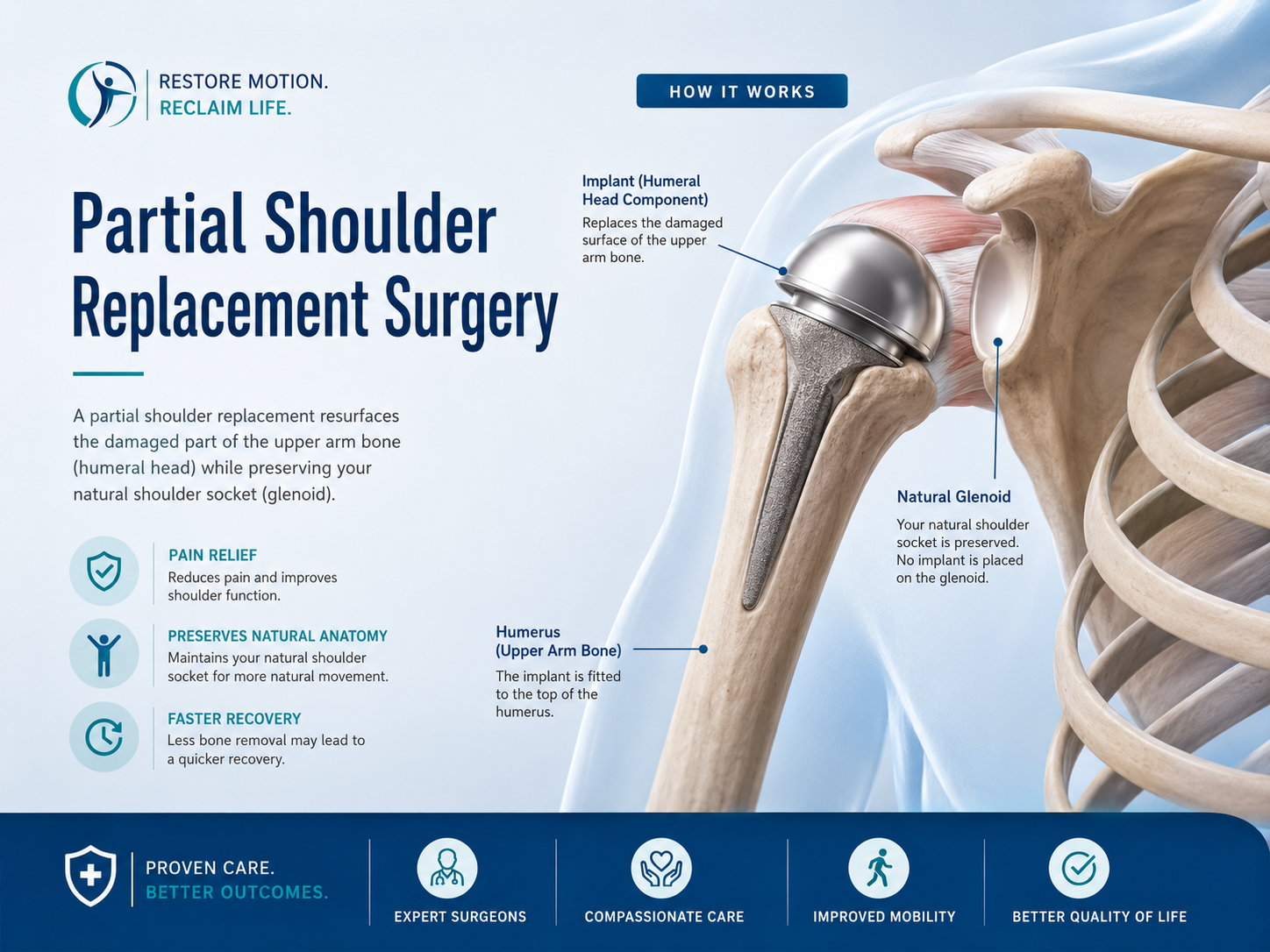
Partial shoulder replacement involves replacing only the damaged ball portion (humeral head) of the shoulder joint with a metal implant while preserving the natural socket (glenoid). Unlike a total shoulder replacement, where both sides of the joint are replaced, partial replacement is typically recommended when the socket cartilage remains relatively healthy.
Who May Need a Partial Shoulder Replacement?
Partial shoulder replacement may be recommended for patients with:
- Advanced arthritis affecting mainly the humeral head
- Severe fractures of the upper arm bone that cannot be reconstructed
- Avascular necrosis (loss of blood supply to the humeral head)
- Certain post-traumatic shoulder conditions
- Younger patients where preserving bone stock is desirable
A detailed clinical examination and advanced imaging studies at a specialized bone and joint clinic in BTM Layout such as X-rays, CT scans, or MRI help determine whether a patient is a suitable candidate.
Benefits of Partial Shoulder Replacement
- Pain Relief: The primary goal of surgery is to reduce chronic shoulder pain that affects quality of life.
- Improved Shoulder Function: Most patients experience better mobility and improved ability to perform routine activities after recovery.
- Bone Preservation: Since only the damaged portion of the joint is replaced, more natural bone is preserved compared to total shoulder replacement.
- Shorter Surgical Time: Partial replacements are generally less extensive procedures and may involve reduced operative time.
- Easier Future Revision Surgery: If additional degeneration occurs later, conversion to a total shoulder replacement is often possible.
Risks of Partial Shoulder Replacement Surgery
Like all surgical procedures, partial shoulder replacement carries certain risks.
- Infection: Although uncommon, infection around the implant can occur and may require additional treatment or surgery.
- Stiffness: Some patients may experience persistent shoulder stiffness despite rehabilitation.
- Continued Pain: If arthritis develops or already exists in the socket portion of the joint, pain may persist even after surgery.
- Implant Loosening: Over time, the implant can loosen, particularly in highly active individuals.
- Wear of the Socket Cartilage: Because the natural socket is retained, cartilage wear may progress and eventually necessitate conversion to a total shoulder replacement.
- Nerve or Blood Vessel Injury: Rarely, nearby nerves or blood vessels can be injured during surgery.
- Fracture: A fracture around the implant can occur during or after surgery, especially in patients with poor bone quality.
- Blood Clots: Though less common in shoulder surgery than lower limb procedures, blood clots remain a potential risk.
What to Expect During Recovery
Recovery is a gradual process and varies depending on the patient's age, bone quality, muscle strength, and overall health. Working alongside an experienced provider of physiotherapy services in Bangalore is essential to safely hitting these key recovery milestones:
- First Few Days: Arm supported in a sling, pain controlled with medications, gentle hand, wrist, and elbow movements encouraged, and early physiotherapy initiated.
- First 6 Weeks: Sling usage as advised by the surgeon, gradual passive range-of-motion exercises, avoiding lifting heavy objects, and focusing on protecting the repair while reducing stiffness.
- 6-12 Weeks: Progression to active shoulder exercises, improvement in strength and mobility, and a return to light daily activities.
- 3-6 Months: Continued strengthening exercises, significant improvement in comfort and function, with most patients resuming normal daily activities.
- Beyond 6 Months: Ongoing improvement in strength and motion, allowing a return to recreational activities as advised by your surgeon.
Factors That Influence Success
Successful outcomes depend on proper patient selection, accurate diagnosis, precise surgical technique, commitment to physiotherapy, and maintaining realistic expectations. Patients with healthy rotator cuff tendons and minimal socket arthritis generally achieve the best results.
When Should You See an Orthopaedic Shoulder Specialist?
Consult an orthopaedic surgeon if you experience:
- Persistent shoulder pain despite conservative treatment
- Difficulty lifting the arm or performing basic overhead tasks
- Severe night pain affecting your sleep
- Progressive loss of shoulder movement
- Shoulder arthritis diagnosed on imaging
Early evaluation from a shoulder surgery specialist in Jayanagar, JP Nagar, and BTM Layout can help determine whether non-surgical treatments remain appropriate or if a partial replacement will provide the best long-term outcome.
Frequently Asked Questions (FAQs)
1. What is the main difference between partial and total shoulder replacement?
In a partial shoulder replacement (hemiarthroplasty), only the damaged ball portion (humeral head) of the joint is replaced with a metal implant, keeping your natural socket intact. A total shoulder replacement replaces both the ball and the socket.
2. Who is the ideal candidate for a partial shoulder replacement in Bangalore?
The ideal candidate is someone suffering from severe pain due to a fracture, avascular necrosis, or arthritis that is strictly limited to the humeral head, provided their natural socket cartilage and rotator cuff tendons remain healthy.
3. How long does the recovery process take after surgery?
Initial recovery and sling usage take about 6 weeks. Active motion and light daily activities resume between 6 to 12 weeks, while full physical recovery and a return to most recreational activities typically occur between 3 to 6 months post-surgery.
4. Can a partial shoulder replacement be converted to a total replacement later?
Yes. If the natural socket cartilage wears out over time or develops advanced arthritis, a partial shoulder replacement can be converted into a total shoulder replacement during a future revision surgery.
5. What are the most common risks involved with this procedure?
While generally safe, the risks include joint stiffness, infection, loosening of the implant over time, progressive wear of the unreplaced socket cartilage, and persistent pain if arthritis spreads to the socket.
6. Will I need physical therapy after a partial shoulder replacement?
Yes, dedicated physiotherapy is crucial to the success of the surgery. It begins with gentle passive movements right after surgery and transitions into structured strengthening exercises over several months to regain full joint functionality.
7. Is partial shoulder replacement suitable for younger patients?
Yes, it is often preferred for younger, active individuals because it preserves natural bone stock, making potential future treatments or joint revisions much easier to manage.
8. Where can I get an expert consultation for shoulder surgery in Bangalore?
You can consult with specialized experts at dedicated bone and joint care centers like the Bangalore Orthopaedic Clinic, which offers comprehensive evaluation, digital diagnostics, and post-surgical rehabilitation.
Conclusion
Partial shoulder replacement surgery in bangalore is a valuable treatment option for carefully selected patients with shoulder arthritis, fractures, or avascular necrosis affecting primarily the humeral head. It can provide substantial pain relief, improved shoulder function, and preservation of natural bone. However, like any surgical procedure, it carries risks that should be discussed thoroughly with an experienced shoulder surgeon. A personalized treatment plan, combined with structured rehabilitation, plays a crucial role in achieving the best possible outcome.
About Dr. Pradyumna R
Dr. Pradyumna R is a Consultant Orthopaedic Surgeon specializing in Shoulder Surgery, Sports Medicine, Arthroscopy, and Joint Preservation Procedures. He has extensive experience in treating complex shoulder conditions, sports injuries, rotator cuff disorders, instability, and shoulder replacement surgeries.
Contact Details
Clinic: Bangalore Orthopaedic Clinic
Location: #450, Ground Floor, 6th Main, 7th Cross, Mico Layout (Opposite Third Wave Coffee), BTM Layout 2nd Stage, Bengaluru, Karnataka 560076
Website: www.drpradyumna.com
Phone: +91 91130 25188
If you're experiencing persistent shoulder pain or have been advised to consider shoulder replacement surgery, schedule a consultation to explore the most appropriate treatment options tailored to your condition.