
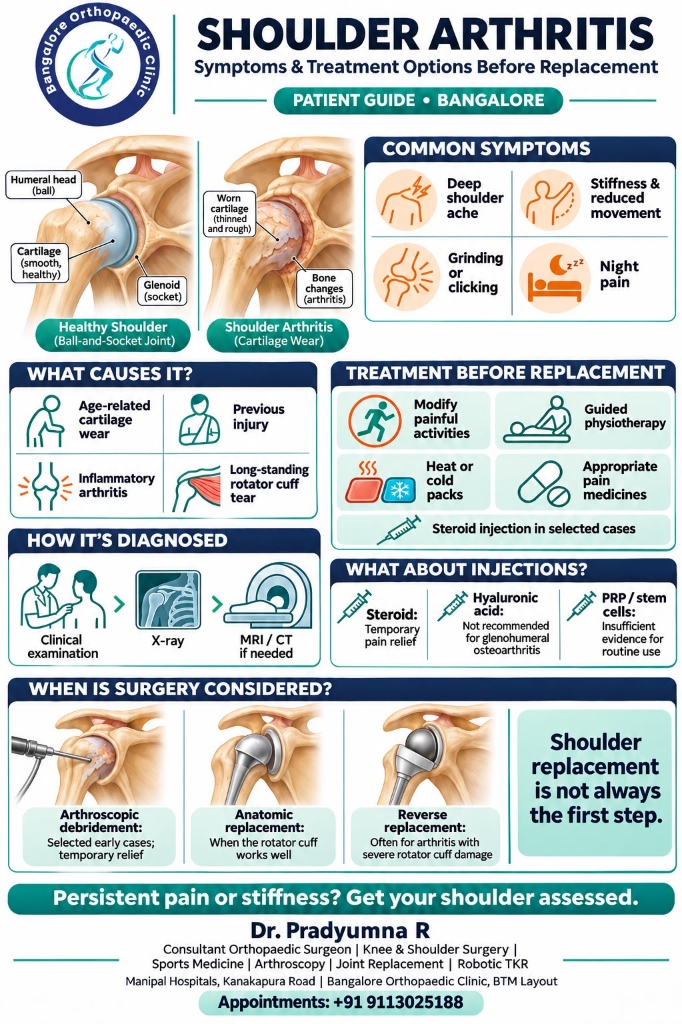
Shoulder pain that makes it difficult to comb your hair, wear a shirt or sleep comfortably is easy to dismiss as a strain. But persistent stiffness may point to shoulder arthritis.
Shoulder arthritis does not automatically mean shoulder replacement. Many patients manage symptoms with activity changes, exercises, medication and sometimes an injection. Treatment depends on the affected joint, cartilage damage and daily limitations.
What Is Shoulder Arthritis?
Arthritis develops when cartilage covering the bones becomes damaged. In the main shoulder joint, the glenohumeral joint, this causes pain, stiffness and sometimes grinding.
The smaller acromioclavicular (AC) joint, at the shoulder's top, can also develop arthritis. These joints may need different treatments.
Common Symptoms of Shoulder Arthritis
- A deep ache in the shoulder, especially during movement
- Pain while dressing, reaching behind the back or lifting objects
- Stiffness and gradually reduced shoulder movement
- Grinding, clicking or a rough sensation inside the joint
- Night pain that disturbs sleep, particularly when lying on that side
Some people have considerable X-ray changes but manageable pain; others struggle daily. Treatment should address the person, not just the scan.
What Causes Shoulder Arthritis?
Causes include age-related wear, an old fracture or dislocation, rheumatoid arthritis and long-standing large rotator cuff tears. Reduced blood supply to bone is a less common cause.
Arthritis can progress, but not at a predictable speed. It does not necessarily worsen every month, and an X-ray showing arthritis does not by itself mean surgery is required.
How Is Shoulder Arthritis Diagnosed?
An orthopaedic surgeon will examine shoulder movement and strength. X-rays are usually the first investigation; they can show joint-space narrowing, bone spurs and bone changes.
MRI helps when a rotator cuff tear is suspected. CT may assess bone shape before surgery. Not everyone needs an MRI.
Shoulder Arthritis Treatment in Bangalore Without Replacement
Most patients begin with non-surgical care. The aim is to reduce pain and preserve useful movement, not to promise that worn cartilage will grow back.
| Treatment option | When it may help | Important limitation |
|---|---|---|
| Activity modification | Pain triggered by repeated overhead work, heavy lifting or gym exercises | Avoid prolonged complete rest |
| Physiotherapy | Stiffness, reduced mobility and weakness where appropriate | Exercises must be tailored; forcing painful movement can aggravate symptoms |
| Heat or cold packs | Short-term stiffness or aching | Offers symptom relief, not cartilage repair |
| Pain medicines | Pain interfering with normal activities | Anti-inflammatory medicines are unsuitable for some people, including those with kidney, stomach or heart problems |
| Corticosteroid injection | Selected patients needing temporary relief | Relief varies; repeated injections and timing before surgery need discussion |
Gentle, guided range-of-motion exercises, such as pendulum movements and comfortable table slides, may help maintain mobility. Avoid heavy overhead presses, painful dips and exercises that consistently cause sharp pain until your shoulder has been assessed.
Do PRP and Hyaluronic Acid Injections Work?
Steroid injections may provide temporary relief, although they do not reverse arthritis. For glenohumeral osteoarthritis, strong guideline evidence shows no meaningful benefit from hyaluronic acid injections. PRP and stem-cell injections have insufficient reliable evidence for routine recommendation. Before paying for an injection, ask what benefit is realistically expected and whether it could affect the timing of future surgery.
Surgical Options Before or Besides Shoulder Replacement
For some patients with early or moderate arthritis, arthroscopic debridement may remove inflamed tissue or loose fragments and provide temporary symptom relief. It does not cure arthritis and is generally less useful in advanced bone-on-bone disease.
When pain and stiffness remain disabling despite adequate non-surgical treatment, shoulder replacement may be discussed:
- Anatomic total shoulder replacement replaces the worn ball and socket and is generally considered when the rotator cuff is functioning well.
- Reverse total shoulder replacement changes the ball-and-socket arrangement and may be preferred when severe rotator cuff damage accompanies arthritis or in certain complex shoulder conditions.
- Partial shoulder replacement replaces only the ball and is suitable for selected situations, not every arthritis patient.
The choice depends on rotator cuff function, bone, age and activity goals.
Frequently Asked Questions
1. What are the symptoms of shoulder arthritis?
Deep shoulder pain, stiffness, loss of movement, grinding and disturbed sleep are common. Simple actions like fastening clothing or reaching a shelf may become uncomfortable.
2. What causes arthritis in the shoulder?
Common causes include age-related wear, previous injuries, inflammatory arthritis and long-standing large rotator cuff tears. The cause helps guide treatment.
3. Does shoulder arthritis get worse over time?
It can progress, but the speed differs greatly between people. Symptoms and X-ray findings do not always progress together.
4. How is shoulder arthritis diagnosed?
Diagnosis usually combines a history, physical examination and X-rays. MRI or CT is used when a tendon injury or complex bone problem needs further assessment.
5. Can shoulder arthritis be treated without surgery?
Yes. Many patients benefit from activity changes, appropriate physiotherapy, pain relief and occasionally a steroid injection, especially when symptoms are manageable.
6. Do steroid, PRP or hyaluronic acid injections help shoulder arthritis?
Steroids may offer short-term pain relief. PRP remains unproven for routine use, and hyaluronic acid is not recommended for glenohumeral osteoarthritis based on current guideline evidence.
7. Which exercises help, and which should I avoid?
Gentle mobility work can help. Avoid heavy or repetitive overhead lifting and any exercise that causes lasting pain. Get an individual physiotherapy plan.
8. Is it shoulder arthritis, a rotator cuff tear or frozen shoulder?
Arthritis often shows changes on X-ray. A rotator cuff tear commonly causes weakness; frozen shoulder markedly limits both active and assisted movement, often without arthritic X-ray changes. These conditions may overlap.
9. When is shoulder replacement needed?
It is considered when persistent pain, poor sleep and limited function remain unacceptable despite suitable non-surgical treatment, with examination and imaging supporting the decision.
10. What surgeries exist before or besides replacement, including reverse replacement?
Arthroscopic debridement may help selected early cases. Anatomic, reverse and partial replacements address different patterns of damage. Reverse shoulder replacement is itself a replacement procedure, not a step before one.
Conclusion
Shoulder arthritis can make ordinary tasks frustrating, but replacement is not the starting point for everyone. An accurate diagnosis and a practical treatment plan may control pain and preserve movement for a considerable time. If shoulder pain or stiffness keeps returning, an orthopaedic assessment can help identify the cause and discuss options before the problem further limits daily life.
Consult Dr. Pradyumna R for evaluation of shoulder pain and arthritis in Bangalore.
Dr. Pradyumna R
Consultant Orthopaedic Surgeon | Knee & Shoulder Surgery | Sports Medicine | Arthroscopy | Joint Replacement | Robotic TKR
Manipal Hospitals, Kanakapura Road | Bangalore Orthopaedic Clinic, BTM Layout
Appointments: +91 9113025188