Shoulder arthritis, large rotator cuff tears, and complex shoulder injuries can sometimes reach a stage where pain and weakness significantly affect everyday life. Simple activities such as reaching a shelf, getting dressed, combing your hair, or sleeping comfortably may become difficult. When the rotator cuff is severely damaged, a conventional shoulder replacement may not provide the stability and movement needed for good shoulder function. In selected patients, a reverse shoulder replacement may be considered. If you are exploring reverse shoulder replacement in Bangalore, understanding why this procedure is different, who may benefit from it, and what recovery involves can help you have a more informed discussion with your orthopaedic surgeon.
What Is a Reverse Shoulder Replacement?
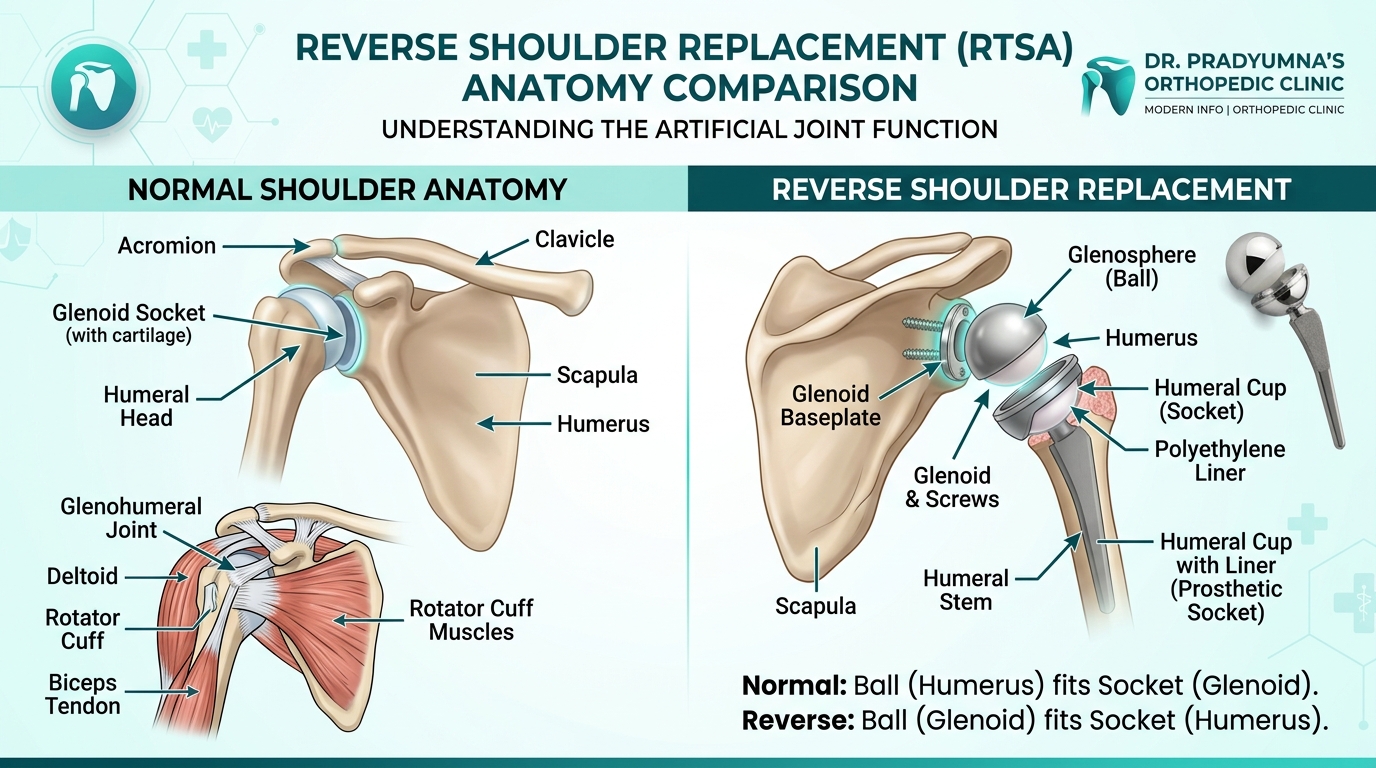
The shoulder is normally a ball-and-socket joint. The rounded head of the upper arm bone, or humerus, forms the ball, while the glenoid of the shoulder blade forms the socket. During a traditional shoulder replacement, artificial components are positioned to reproduce this natural anatomy. In a reverse shoulder replacement, the arrangement is switched:
-
An artificial ball is attached to the socket side of the shoulder.
-
An artificial socket is placed on the upper arm side.
This change in joint mechanics allows the deltoid muscle to play a larger role in lifting and moving the arm when the rotator cuff is severely damaged or no longer functioning adequately.
Why Would Someone Need Reverse Shoulder Replacement?
Reverse shoulder replacement is not the first treatment for ordinary shoulder pain. It may be considered when there is significant damage to the shoulder and other treatment options are unlikely to provide adequate pain relief or function.
Common situations include:
-
Massive, irreparable rotator cuff tears
-
Rotator cuff tear arthropathy, where a large cuff tear is associated with arthritis
-
Advanced shoulder arthritis with poor rotator cuff function
-
Certain complex fractures around the shoulder
-
Severe loss of shoulder function associated with structural damage
Before recommending surgery, the surgeon usually evaluates symptoms, shoulder movement, muscle function, X-rays, and sometimes CT or MRI scans.
Reverse Shoulder Replacement vs Traditional Shoulder Replacement
A traditional shoulder replacement generally works best when the rotator cuff muscles and tendons are functioning reasonably well. These muscles help centre and stabilise the shoulder joint while the arm moves. If the rotator cuff is severely damaged, a traditional replacement may not function effectively. A reverse shoulder replacement changes the biomechanics of the joint so that the deltoid muscle can contribute more effectively to lifting the arm.
However, reverse shoulder replacement is not automatically better than a traditional replacement. The correct procedure depends on the condition of the rotator cuff, bone, cartilage, shoulder anatomy, previous surgery, age, activity requirements, and overall health. Learn more about partial shoulder replacement and other alternatives.
What Does Recovery After Reverse Shoulder Replacement Look Like?
Recovery is gradual. Immediately after surgery, the arm is usually supported in a sling. Pain medication, ice, wound care, and carefully controlled movement are used during the early recovery period. Movement of the fingers, wrist, and elbow generally begins early. Shoulder exercises and physiotherapy are introduced according to the surgeon’s rehabilitation protocol.
As healing progresses, exercises usually move through stages:
Early Phase
Protect the surgical repair and begin controlled movement.
Intermediate Phase
Gradually improve range of motion and begin appropriate strengthening.
Later Phase
Improve shoulder strength, coordination, and functional use of the arm.
Many patients notice substantial improvement during the first three to six months, although strength, movement, and confidence in using the shoulder can continue improving for six to twelve months. Recovery differs from person to person, particularly after previous shoulder surgery, fractures, or complex reconstruction.
10 Frequently Asked Questions About Reverse Shoulder Replacement
1. What is reverse shoulder replacement?
Reverse shoulder replacement, also called reverse total shoulder arthroplasty, is a type of joint replacement in which the normal ball-and-socket arrangement of the shoulder is reversed. An artificial ball is placed on the shoulder blade side, while an artificial socket is attached to the upper arm bone. This design allows the deltoid muscle to help move the arm even when the rotator cuff is severely damaged.
2. Who is a candidate for reverse shoulder replacement?
Potential candidates may include patients with:
- Massive, irreparable rotator cuff tears
- Rotator cuff tear arthropathy
- Advanced arthritis combined with poor rotator cuff function
- Certain complex fractures
- Significant loss of shoulder function
- Failed previous shoulder replacement
Not everyone with arthritis or a rotator cuff tear requires shoulder replacement. The decision should be made after clinical examination and appropriate imaging.
3. Why is reverse shoulder replacement different from traditional shoulder replacement?
Traditional shoulder replacement recreates the shoulder’s natural ball-and-socket anatomy and generally relies on a functioning rotator cuff. Reverse shoulder replacement switches the positions of the ball and socket. This alters the mechanics of the shoulder and allows the deltoid muscle to compensate for some of the function normally provided by the rotator cuff.
4. Is reverse shoulder replacement suitable for rotator cuff tears?
It may be suitable for some patients with large or irreparable rotator cuff tears, particularly when there is associated arthritis, significant weakness, or inability to lift the arm. Most rotator cuff tears do not require shoulder replacement. Smaller or repairable tears may be treated with physiotherapy, injections in selected cases, arthroscopic repair, or other approaches depending on the patient’s symptoms and injury.
5. How long does reverse shoulder replacement surgery take?
A primary reverse shoulder replacement commonly takes approximately one to three hours, although operating time varies. Revision surgery, significant bone loss, fractures, or other complex conditions may take longer. The surgeon can give a more realistic estimate after reviewing imaging and planning the procedure.
6. How painful is reverse shoulder replacement?
Some postoperative discomfort should be expected because this is a major joint operation. Modern pain management may include anaesthesia, a regional nerve block in suitable patients, pain medication, ice, and gradual rehabilitation. Pain is usually more noticeable during the early postoperative period and gradually improves as healing progresses. Patients should contact their treating team if pain suddenly becomes much worse or is accompanied by fever, increasing redness, drainage, marked swelling, or other concerning symptoms.
7. How long does recovery take after reverse shoulder replacement?
Recovery occurs in stages rather than on a single fixed timeline. Many patients make considerable functional progress during the first three to six months. Further improvement in strength, movement, and function may continue for six to twelve months. Recovery can take longer after revision surgery or complex fractures. The final result also depends on the patient’s preoperative shoulder function, muscle strength, bone quality, rehabilitation, and underlying condition.
8. When can I start physiotherapy after reverse shoulder replacement?
Rehabilitation often begins early, sometimes during the hospital stay or shortly after surgery. However, the exercises performed in the first few weeks are intentionally controlled. The timing of passive movement, active movement, and strengthening depends on surgical findings, implant stability, bone quality, and whether additional procedures were performed. Patients should therefore follow their surgeon and physiotherapist’s specific programme rather than starting strengthening exercises independently.
9. What activities should I avoid after reverse shoulder replacement?
During early recovery, patients may be advised to avoid:
- Heavy lifting
- Sudden pulling or jerking movements
- Pushing body weight through the operated arm
- Reaching forcefully behind the back
- Unsupported or uncontrolled overhead movements
- Activities that could result in a fall
Restrictions gradually change as the shoulder heals. Even after recovery, very heavy repetitive lifting or high-impact activities may not be advisable for some patients. Discuss gym exercises, sports, swimming, golf, and occupational lifting with your surgeon before returning to them.
10. How much does reverse shoulder replacement cost in Bangalore?
The cost of reverse shoulder replacement in Bangalore can vary significantly. The total expense may depend on:
- Type and brand of implant
- Hospital and room category
- Complexity of surgery
- Whether it is a primary or revision replacement
- Anaesthesia
- Investigations and imaging
- Length of hospital stay
- Additional procedures or bone grafting
- Medications
- Physiotherapy and rehabilitation
- Insurance coverage
Published estimates for shoulder replacement in Bangalore vary widely, so online figures should be treated only as approximate planning ranges. A more accurate estimate can usually be provided after the surgeon examines the patient, reviews the X-rays or scans, and decides which implant and procedure are appropriate.
Conclusion
Reverse shoulder replacement has changed the treatment options available for patients with complex shoulder problems, particularly when severe rotator cuff damage makes a conventional shoulder replacement less suitable. The procedure works differently from a normal shoulder replacement by allowing the deltoid muscle to play a greater role in moving the arm. However, surgery should be considered only after the cause of pain and loss of function has been properly assessed. Not every rotator cuff tear or arthritic shoulder requires replacement surgery. For appropriately selected patients, reverse shoulder replacement may help reduce pain and improve the ability to perform everyday activities. Recovery requires patience, appropriate protection of the shoulder in the early weeks, and a structured rehabilitation programme.
If shoulder pain, weakness, arthritis, or a rotator cuff injury is significantly affecting daily activities, consultation with a shoulder surgeon can help determine whether non-surgical treatment, rotator cuff surgery, conventional shoulder replacement, or reverse shoulder replacement is the most appropriate option.