
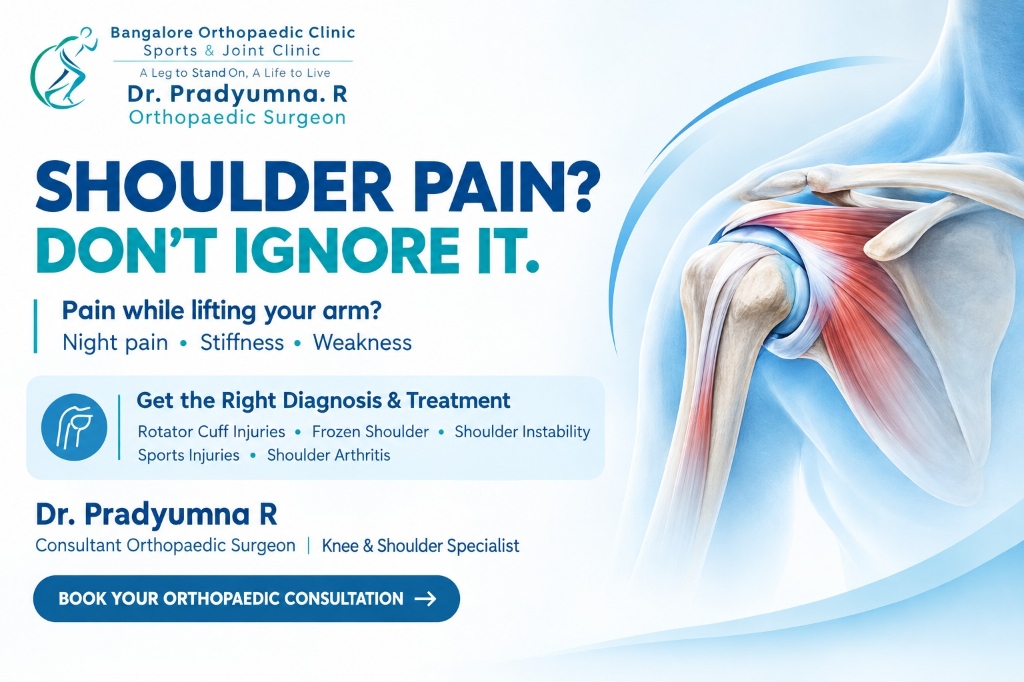
Shoulder pain can start as a mild discomfort while lifting your arm, reaching overhead, exercising, or sleeping on one side. For some people, it settles with rest and simple measures. For others, the pain gradually becomes more persistent, starts affecting sleep, or makes everyday activities such as dressing, driving, working, or playing sports difficult. Because the shoulder is one of the most mobile joints in the body, pain can arise from several different structures, including the muscles, tendons, ligaments, cartilage, joint capsule, and bones. Identifying the actual cause is important before deciding on treatment. If you are looking for shoulder pain treatment in Bangalore, an orthopaedic assessment can help determine whether the problem is related to overuse, a rotator cuff injury, frozen shoulder, instability, arthritis, or another condition. Most shoulder problems do not automatically require surgery. Treatment is usually based on the cause of pain, severity of symptoms, duration of the problem, activity level, examination findings, and imaging when required.
What Causes Shoulder Pain?
The shoulder is formed by a combination of joints, muscles, and tendons that allow the arm to move through a wide range of motion. This flexibility also means that several structures can become irritated or injured.
Common causes of shoulder pain include:
-
Subacromial bursitis
-
Acromioclavicular (AC) joint injuries
-
Falls or direct trauma
-
Repetitive overhead activity
-
Age-related tendon degeneration
Sometimes pain felt around the shoulder may actually originate from the neck or another nearby structure, which is another reason why a clinical examination is important.
When Should Shoulder Pain Be Evaluated?
Occasional soreness after strenuous activity may improve with activity modification and gentle movement. However, persistent pain should not simply be ignored.
Consider seeing an orthopaedic surgeon if:
-
Shoulder pain continues or keeps returning
-
Pain is interfering with sleep (night pain)
-
You cannot comfortably raise your arm
-
You have noticeable weakness
-
The shoulder feels unstable or repeatedly slips out
-
Pain began after a fall, accident, or sports injury
-
You have increasing stiffness
-
Everyday activities are becoming difficult
-
Pain is gradually becoming more severe
-
Previous physiotherapy or medication has not provided adequate improvement
Medical evaluation should be sought more urgently following significant trauma, if the shoulder appears deformed or severely swollen, if you suddenly cannot move the arm, or if persistent numbness or loss of sensation develops. Fever or feeling unwell along with a painful, swollen shoulder also requires prompt assessment.
How Is Shoulder Pain Diagnosed?
Successful shoulder pain treatment in Bangalore begins with identifying what is causing the symptoms rather than treating every shoulder problem in the same way.
During an orthopaedic consultation, your doctor may ask about:
-
When the pain started
-
Whether there was an injury
-
Where the pain is located
-
Activities that make it worse
-
Whether pain occurs at night
-
Whether there is weakness or stiffness
-
Sports and occupational activities
-
Previous shoulder injuries or dislocations
The shoulder is then examined for tenderness, movement, strength, stability, and specific patterns of pain.
Depending on the suspected condition, imaging may include:
X-ray
X-rays are useful for assessing bones, arthritis, fractures, changes in joint alignment, and certain other structural abnormalities.
Ultrasound
Ultrasound can help evaluate soft-tissue structures such as the rotator cuff tendons.
MRI
An MRI provides detailed images of muscles, tendons, cartilage, the labrum, and other soft tissues. It may be advised when a rotator cuff tear, labral injury, or another significant soft-tissue problem is suspected.
For rotator cuff injuries specifically, clinical examination combined with MRI or ultrasound can help identify a tear and determine its extent.
Treatment Options for Shoulder Pain
Treatment varies considerably depending on the diagnosis.
Activity Modification
Temporarily reducing movements that repeatedly aggravate the shoulder can allow irritated tissues to settle. Complete prolonged immobilisation is usually not desirable unless specifically advised because excessive inactivity can contribute to stiffness.
Medication
Pain-relieving or anti-inflammatory medicines may sometimes be recommended depending on the patient’s medical history and condition. Medication should be used under appropriate medical guidance, particularly when it needs to be taken repeatedly or for an extended period.
Physiotherapy
Physiotherapy plays an important role in many shoulder conditions. A rehabilitation programme may focus on:
- Restoring shoulder movement
- Improving rotator cuff strength
- Strengthening muscles around the shoulder blade
- Improving posture and movement mechanics
- Gradually restoring overhead activity
- Returning safely to work or sport
Structured strengthening and flexibility programmes can improve shoulder stability and range of motion when appropriately selected for the underlying condition.
Injections
For selected conditions, an injection may be considered to help reduce inflammation and pain. However, injections are not necessary for every patient and should be considered based on the diagnosis rather than being used as a routine treatment for all shoulder pain.
Surgery
Most people presenting with shoulder pain do not immediately require an operation. Surgery may be considered for certain structural injuries, recurrent instability, significant traumatic tendon tears, persistent symptoms despite appropriate non-surgical treatment, or conditions where shoulder function remains substantially limited. The appropriate treatment should therefore be decided after examining the shoulder and understanding the patient’s functional requirements. Learn more about shoulder arthroscopy in Bangalore.
10 Frequently Asked Questions About Shoulder Pain Treatment
1. What are the common causes of shoulder pain?
Common causes include rotator cuff tendinopathy or tears, shoulder impingement, bursitis, frozen shoulder, arthritis, instability, dislocation, biceps tendon problems, labral injuries, AC joint problems, repetitive overhead activity, and sports injuries. The pattern of pain, weakness, stiffness, and movement restriction often provides clues about which structure may be involved.
2. When should I see an orthopaedic surgeon for shoulder pain?
Consider an orthopaedic consultation if the pain persists, keeps recurring, affects sleep, restricts movement, causes weakness, interferes with work or sports, or follows an injury. Sudden severe pain, inability to move the arm, deformity, significant swelling, persistent numbness, or pain associated with fever should be assessed promptly.
3. Can shoulder pain heal without treatment?
Some mild strains and temporary overuse-related problems can improve with activity modification and time. However, persistent symptoms should not automatically be assumed to be a minor strain. Conditions such as rotator cuff injuries, frozen shoulder, instability, and arthritis may require a structured treatment or rehabilitation programme.
4. How is the cause of shoulder pain diagnosed?
Diagnosis usually begins with your medical history and a detailed physical examination. The surgeon evaluates shoulder movement, strength, stability, painful movements, and specific structures around the joint. X-rays, ultrasound, or MRI may be recommended depending on the suspected condition. Not every patient requires an MRI.
5. What treatment is available for chronic shoulder pain?
Treatment depends on the diagnosis and may include:
- Activity modification
- Medication when appropriate
- Physiotherapy
- Strengthening and mobility exercises
- Selected injections
- Treatment of underlying instability or tendon problems
- Arthroscopic or other surgical procedures when indicated
The goal is not simply to suppress pain but to identify and address the condition contributing to it.
6. Can physiotherapy help with shoulder pain?
Yes. Physiotherapy is an important treatment for many shoulder conditions. Exercises may improve range of motion, shoulder blade control, rotator cuff strength, flexibility, and overall shoulder mechanics. The type of exercise matters, however. A programme designed for frozen shoulder may be different from rehabilitation for instability or a rotator cuff injury. Exercises are therefore best selected according to the diagnosis.
7. What are the symptoms of a rotator cuff injury?
Possible symptoms include:
- Pain while lifting the arm
- Pain during overhead activity
- Pain while reaching behind the back
- Night pain, particularly while lying on the affected shoulder
- Weakness while lifting or rotating the arm
- Difficulty performing sports or routine activities
Rotator cuff tears may develop gradually through tendon degeneration or occur suddenly following an injury such as a fall. The size of a tear and severity of symptoms can vary significantly between patients, so imaging findings should be interpreted along with the clinical examination.
8. Can shoulder pain be caused by a frozen shoulder?
Yes. Frozen shoulder, or adhesive capsulitis, typically causes both pain and progressive stiffness. Patients often notice increasing difficulty reaching overhead, behind their back, or performing activities such as dressing. Treatment commonly involves pain management and physiotherapy aimed at gradually restoring movement. Surgery is only required in a minority of cases when symptoms do not respond adequately to non-surgical treatment. Recovery can be gradual, so recognising the condition and following an appropriate rehabilitation programme is important.
9. When does shoulder pain require surgery?
Shoulder pain itself does not determine whether surgery is necessary. Surgery may be discussed when there is a condition such as:
- A significant traumatic rotator cuff tear
- Recurrent shoulder dislocation or instability
- Certain labral injuries
- Persistent rotator cuff problems despite appropriate treatment
- Advanced arthritis
- Significant structural injury
- Ongoing pain and functional limitation despite adequate non-surgical management
Even with rotator cuff tears, treatment decisions depend on factors such as the patient’s age, activity level, how the tear occurred, tear size, general health, pain, weakness, and functional requirements. Not every rotator cuff tear requires immediate surgery.
10. How much does shoulder pain treatment cost in Bangalore?
The cost of shoulder pain treatment in Bangalore varies because shoulder pain is a symptom rather than a single diagnosis. Costs may depend on whether treatment requires:
- Orthopaedic consultation
- X-rays
- Ultrasound or MRI
- Medication
- Physiotherapy
- Injection treatment
- Day-care procedures
- Arthroscopic surgery
- Implants, when required
- Hospitalisation and rehabilitation
A patient with a simple overuse injury requiring physiotherapy will naturally have a very different treatment cost from someone requiring arthroscopic rotator cuff repair or instability surgery. For this reason, an accurate estimate is usually possible only after diagnosis and a treatment plan have been established.
Conclusion
Shoulder pain may seem minor initially, but persistent pain, weakness, stiffness, night discomfort, or difficulty lifting the arm can indicate an underlying problem that deserves evaluation. The good news is that many shoulder conditions can be managed without surgery when diagnosed appropriately. Physiotherapy, activity modification, targeted rehabilitation, medication, or selected injections may be sufficient for many patients. When structural damage, recurrent instability, significant tendon injury, or persistent symptoms are present, an orthopaedic surgeon can determine whether further investigation or surgical treatment should be considered.
If shoulder pain is limiting your sleep, work, exercise, sports, or everyday activities, an evaluation can help identify the cause and create a treatment plan appropriate for your shoulder rather than relying on temporary pain relief alone.