
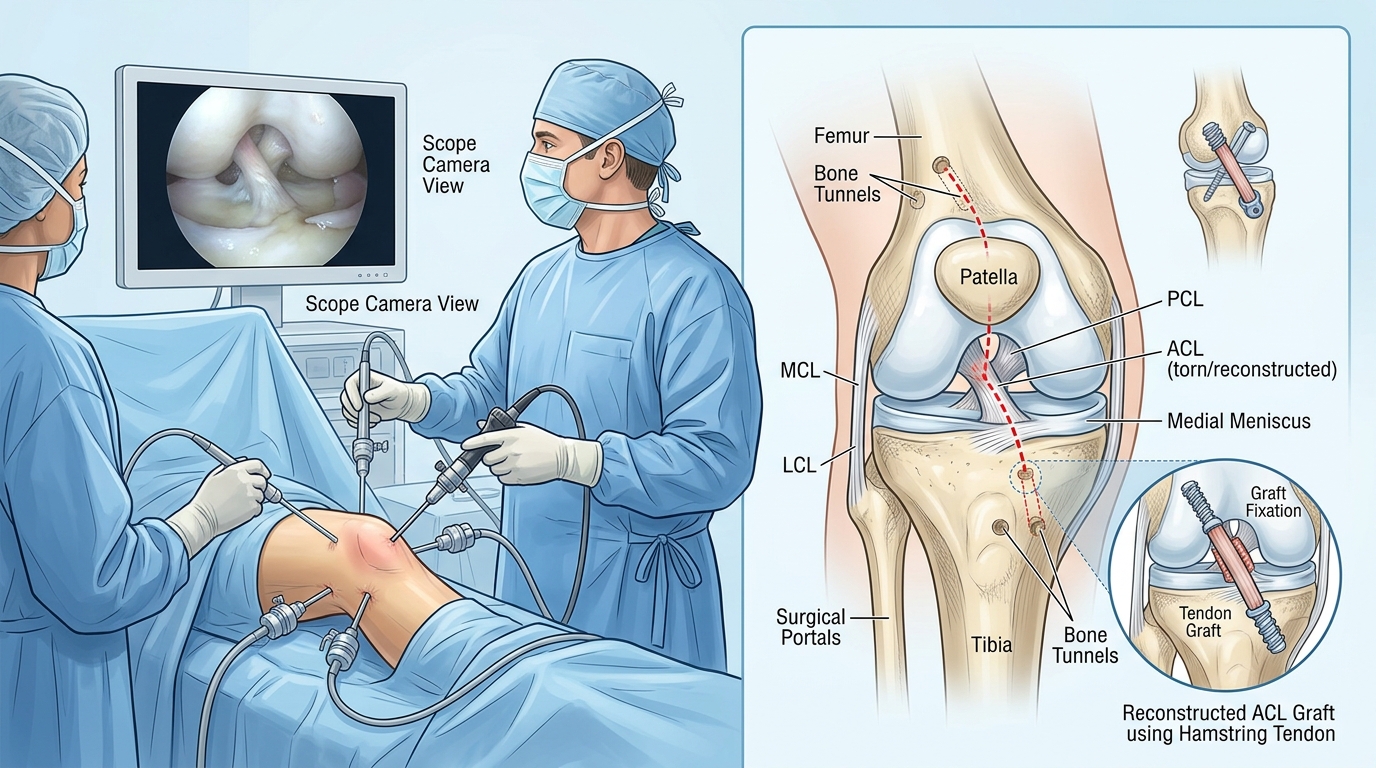
Hearing that you have torn your anterior cruciate ligament (ACL) can be unsettling, particularly when surgery is recommended. Questions about the procedure, anaesthesia, pain and recovery are completely understandable. The encouraging part is that ACL reconstruction surgery is a well-established procedure designed to restore knee stability and help patients return to their desired activities. But what actually happens inside the operating theatre? How is the new ligament positioned, and what should you expect afterwards? This guide explains the process, from preparing for surgery to rehabilitation and recovery.
Understanding ACL Reconstruction Surgery
The anterior cruciate ligament is one of the main stabilising ligaments inside the knee. It connects the thigh bone (femur) to the shin bone (tibia) and helps control excessive forward movement and rotation. An ACL tear commonly occurs during sudden changes in direction, awkward landings or twisting movements, particularly in sports such as football, basketball and badminton. When the ACL is completely torn, the knee may become unstable or give way during certain movements. ACL reconstruction surgery replaces the damaged ligament with a tendon graft, creating a new structure that helps restore stability. However, not every ACL tear requires surgery. The decision depends on knee stability, activity demands, associated injuries and response to rehabilitation.
Preparing for ACL Reconstruction Surgery
Preparation begins well before entering the operating theatre. Your orthopaedic surgeon will examine the knee and review MRI findings to assess the ACL, menisci, cartilage and other ligaments. If the knee is significantly swollen or stiff, physiotherapy may be recommended before surgery. This is often called prehabilitation. The aim is to reduce swelling, restore knee extension, improve movement and strengthen the surrounding muscles. Your surgical team will also review your medical history, medications and anaesthesia requirements. Having a relatively calm, mobile knee before reconstruction can help make postoperative rehabilitation smoother.
How Is ACL Reconstruction Surgery Performed? Step by Step
ACL reconstruction is generally performed using arthroscopy, a minimally invasive technique involving a small camera and specialised surgical instruments. Although techniques vary, the procedure typically follows these stages.
Step 1: Anaesthesia and Knee Assessment
The procedure begins after general or spinal anaesthesia has been administered. Once the patient is comfortable, the surgeon examines the knee to assess ligament stability and confirm the surgical plan. The leg is then positioned and prepared under sterile conditions.
Step 2: Arthroscopic Examination
Small incisions are made around the front of the knee. An arthroscope, a narrow instrument containing a camera, is introduced into the joint. Images displayed on a monitor allow the surgeon to examine the internal structures. The ACL injury is assessed, along with the menisci and cartilage. If a meniscus tear is present, it may be repaired or otherwise treated during the same operation.
Step 3: Preparing the Tendon Graft
A healthy tendon graft is prepared to replace the damaged ACL. Common graft sources include the hamstring tendon, patellar tendon and quadriceps tendon. When using the patient’s own tendon, an additional incision is made to obtain the required tissue. The graft is measured, prepared and reinforced with sutures so that it can be positioned securely.
Step 4: Preparing the Bone Tunnels
The surgeon creates carefully positioned tunnels in the femur and tibia. These tunnels follow the intended anatomical pathway of the ACL. Accurate tunnel placement is important because the graft must reproduce the ligament’s stabilising function without restricting normal knee movement.
Step 5: Positioning the New ACL
The prepared tendon graft is passed through the bone tunnels and positioned across the knee joint. It is secured using suitable fixation devices, which may include screws, buttons or other implants. The objective is to hold the graft securely while biological healing takes place.
Step 6: Testing Knee Stability
After fixation, the surgeon checks graft tension, knee movement and stability. The knee is gently moved through its range of motion to assess whether the graft functions appropriately. Adjustments may be made when necessary.
Step 7: Closing the Incisions
The instruments are removed, and the incisions are closed with sutures or other appropriate closure methods. Sterile dressings are applied, and the patient is transferred to the recovery area. A knee brace or crutches may be recommended depending on the reconstruction and any additional procedures performed.
Which ACL Graft Is Best?
There is no single graft that is ideal for every patient.
-
Hamstring tendon graft: Commonly used and generally associated with less discomfort when kneeling compared with patellar tendon grafts. Some patients may experience temporary or persistent hamstring weakness.
-
Patellar tendon graft: Uses a portion of the tendon connecting the kneecap to the shinbone, usually with small bone blocks. It offers reliable fixation but may cause anterior knee pain or discomfort when kneeling.
-
Quadriceps tendon graft: Provides a substantial graft and is increasingly used for primary and revision ACL reconstruction. Temporary quadriceps weakness and discomfort at the harvest site may occur.
The choice depends on age, sporting demands, anatomy, previous surgery and individual clinical considerations.
What Happens After ACL Reconstruction?
The first few days usually involve some pain, swelling and difficulty moving the knee comfortably. Pain medication, icing, elevation and appropriate mobilisation help manage these symptoms.
Rehabilitation is essential. Initially, physiotherapy focuses on controlling swelling, restoring knee extension, regaining muscle activation and improving walking. Over subsequent weeks, treatment progresses towards strengthening, balance and functional exercises. Higher-demand activities, such as pivoting sports, generally require a longer rehabilitation programme. Return to competitive sport commonly takes 9–12 months or longer, depending on strength, stability, functional testing and recovery progress.
Surgery provides the structural reconstruction. Rehabilitation helps the knee regain the strength and control needed for everyday activities and sport.
Frequently Asked Questions About ACL Reconstruction Surgery
1. What is ACL reconstruction surgery and when is it needed?
ACL reconstruction replaces a torn ACL with a tendon graft to restore knee stability. It may be recommended for patients experiencing repeated instability, those wishing to return to pivoting sports, or individuals with associated meniscus or ligament injuries.
2. How is ACL reconstruction surgery performed step by step?
The surgeon examines the knee arthroscopically, prepares a tendon graft, creates bone tunnels, positions and secures the graft, and checks knee stability before closing the incisions. Associated injuries may be treated during the same procedure.
3. Which graft is used in ACL reconstruction (hamstring, patellar tendon, quadriceps)?
All three are established options. Hamstring grafts may reduce kneeling discomfort, patellar tendon grafts provide reliable fixation, and quadriceps tendon grafts offer substantial tissue. Graft selection is individualised rather than determined by a single universally superior option.
4. How long does ACL reconstruction surgery take?
ACL reconstruction typically takes approximately 1–3 hours. Surgical duration varies depending on graft selection, the complexity of the injury and whether additional procedures, such as meniscus repair, are required.
5. Is ACL surgery done under general or spinal anaesthesia?
Both are possible. General anaesthesia keeps the patient asleep, while spinal anaesthesia numbs the lower body. Additional regional nerve blocks may help control postoperative pain. The anaesthetist recommends the most appropriate approach.
6. Is ACL reconstruction painful, and how is pain managed afterwards?
Pain and swelling are expected after surgery, especially during the first few days. Treatment may include prescribed pain medication, regional nerve blocks, icing, elevation and early guided physiotherapy. Discomfort generally improves gradually as healing progresses.
7. How many days do I stay in the hospital after ACL surgery?
Many patients can return home on the same day. Some require an overnight stay for observation, pain management or additional medical needs. Discharge depends on recovery from anaesthesia, safe mobility and the surgical team’s assessment.
8. Can a torn ACL heal without surgery?
Some partial tears and selected ACL injuries may demonstrate healing. However, complete tears often do not reliably regain normal stability. Structured physiotherapy can be effective for patients whose knees remain functionally stable and whose activity demands are suitable for non-operative treatment.
9. What are the risks and complications of ACL reconstruction?
Possible complications include infection, blood clots, knee stiffness, persistent discomfort, graft failure, continued instability and occasional nerve or blood vessel injury. Most patients recover without major complications, but recognising unusual swelling, fever or worsening pain is important.
10. Who is a good candidate for ACL reconstruction, and who is not?
Patients with symptomatic instability, high-demand sporting goals or associated injuries may benefit from reconstruction. Those with stable knees and lower activity demands may manage well with rehabilitation. Significant medical risks, active infection or difficulty participating in rehabilitation may require surgery to be postponed or reconsidered.
Conclusion
ACL reconstruction surgery is more than simply replacing a torn ligament. Successful treatment involves careful patient selection, appropriate graft choice, accurate surgical technique and structured rehabilitation. Understanding each stage helps patients prepare realistically and participate confidently in their recovery. For individuals experiencing persistent knee instability after an ACL injury, a detailed orthopaedic assessment can help determine whether reconstruction or continued non-surgical treatment is the more appropriate option.