
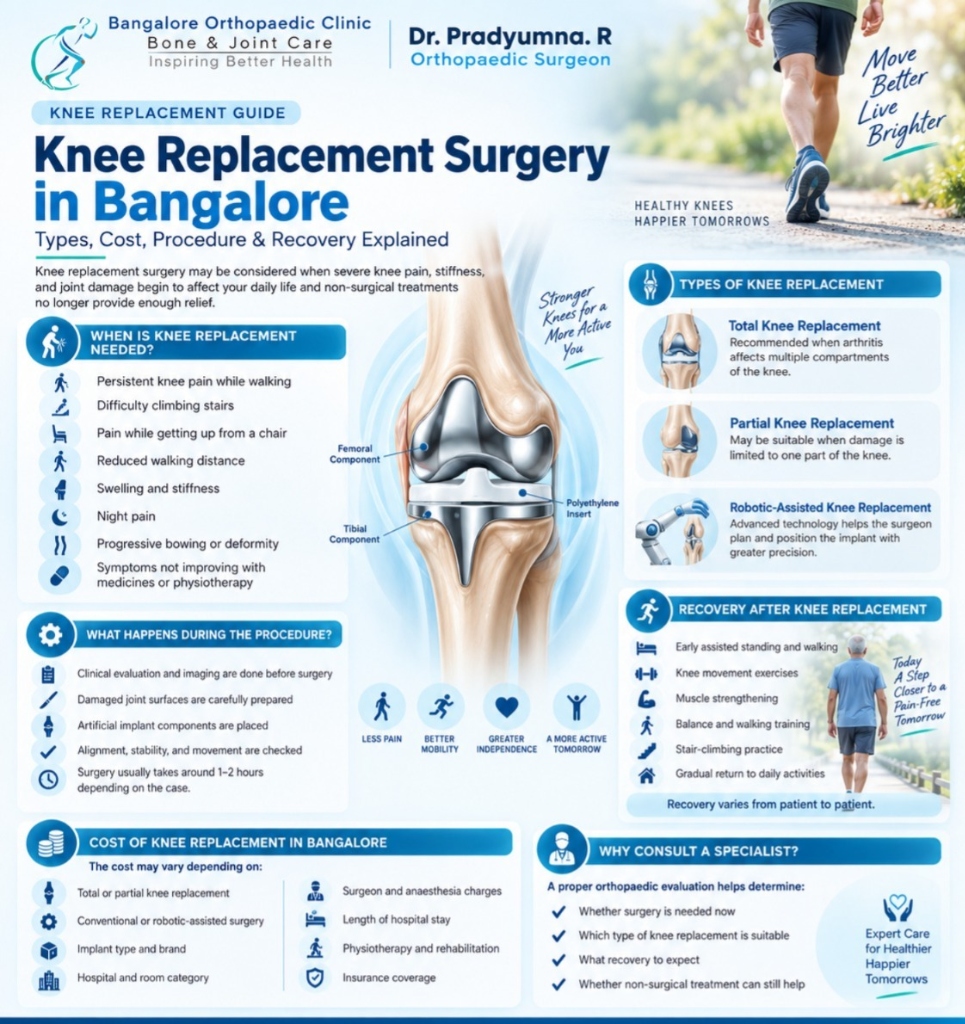
Knee pain can gradually change the way you live. What may begin as discomfort while climbing stairs can eventually make everyday activities—walking, getting up from a chair, travelling, exercising, or even sleeping comfortably—more difficult. For many people, medicines, physiotherapy, activity modification, weight management, and injections can help control knee pain for a considerable period. However, when arthritis or joint damage becomes advanced and these treatments no longer provide adequate relief, knee replacement surgery may be considered. If you are exploring knee replacement surgery in Bangalore, understanding the different surgical options, approximate costs, procedure, and recovery process can make the decision less overwhelming.
What Is Knee Replacement Surgery?
Knee replacement, also known as knee arthroplasty, is a surgical procedure in which damaged portions of the knee joint are resurfaced and replaced with artificial components. The knee is made up primarily of the femur (thigh bone), tibia (shin bone), and patella (kneecap). The ends of these bones are normally covered by smooth cartilage that allows the joint to move with minimal friction. Conditions such as knee cartilage wear and osteoarthritis can gradually wear this cartilage down. As the joint becomes increasingly damaged, patients may experience pain, stiffness, swelling, reduced movement, deformity, and difficulty walking.
During knee replacement surgery, the surgeon removes the damaged joint surfaces and positions specially designed implants to recreate a smooth and stable joint surface. The aim is not simply to replace a painful knee. The procedure is planned to improve mobility, alignment, stability, and day-to-day function while reducing pain caused by the damaged joint.
When Is Knee Replacement Surgery Recommended?
Not every person with knee arthritis needs surgery. In the earlier stages, non-surgical treatment may include:
-
Physiotherapy and Strengthening Exercises: Targeted exercises to improve joint mobility and support muscles.
-
Weight Management: Reducing body weight to minimize load across the knee joint.
-
Activity Modification: Adjusting daily activities to reduce joint stress and discomfort.
-
Medications: Pain-relieving or anti-inflammatory medication when appropriate.
-
Knee Injections: Intra-articular knee injections in selected patients.
-
Lifestyle Modifications: Ergonomic adjustments and joint-friendly daily habits.
Knee replacement may be discussed when knee damage becomes advanced and symptoms significantly interfere with everyday life despite appropriate non-surgical treatment. Common concerns include persistent pain while walking, difficulty climbing stairs, pain while standing from a seated position, reduced walking distance, stiffness, night pain, and progressive bowing or other deformity of the knee. The decision should be based on the patient’s symptoms, examination, X-rays or other imaging, overall health, and expectations rather than an X-ray alone.
Types of Knee Replacement Surgery
There is no single knee replacement procedure that is right for every patient.
Total Knee Replacement
A total knee replacement (TKR) is commonly considered when arthritis affects multiple compartments of the knee. The damaged joint surfaces are carefully prepared and replaced with metal components, with a medical-grade polyethylene insert between them to allow smooth movement. Despite the name, the entire knee is not removed. The procedure primarily involves resurfacing the damaged portions of the joint.
Partial Knee Replacement
A partial or unicompartmental knee replacement may be an option when arthritis is limited to one specific compartment of the knee and the remaining joint structures are suitable. Because less of the knee is resurfaced, more of the patient’s natural bone and joint structures can be preserved. However, partial knee replacement is not suitable for everyone. Careful assessment is important because arthritis affecting several parts of the knee may be better treated with total knee replacement.
Robotic-Assisted Knee Replacement
Robotic-assisted knee replacement technology can be used to assist the surgeon during certain knee replacement procedures. Before or during surgery, information about the patient’s anatomy is used to create a surgical plan. The robotic system can then help the surgeon execute planned bone preparation and implant positioning with a high degree of control. An important point for patients to understand is that the robot does not independently perform the operation. The orthopaedic surgeon remains responsible for the procedure and makes the surgical decisions. Robotic technology is a surgical tool rather than a replacement for the surgeon’s judgement and experience.
Total vs Partial Knee Replacement
The main difference is how much of the knee needs to be resurfaced. In a total knee replacement, multiple damaged surfaces of the knee are treated. In a partial replacement, only the compartment affected by arthritis is resurfaced. Partial knee replacement may preserve more natural bone and tissue and can offer a different recovery experience in appropriately selected patients. However, it requires the arthritis to be sufficiently localised. Rather than choosing a procedure simply because it sounds less invasive, the better approach is to determine which operation matches the actual pattern of damage in the knee.
Is Robotic Knee Replacement Better Than Traditional Knee Replacement?
This is one of the most common questions patients ask today. Robotic-assisted vs traditional knee replacement: Robotic-assisted knee replacement can help surgeons with detailed planning and precise execution of the planned bone cuts and implant positioning. Traditional knee replacement, however, remains a well-established surgical technique and can also provide good outcomes when appropriately performed. Robotic technology does not automatically mean that every patient will recover faster or achieve a better result. The choice depends on factors such as the patient’s anatomy, type and severity of arthritis, deformity, implant requirements, available technology, and the surgeon’s assessment. For patients considering robotic knee replacement in Bangalore, it is useful to discuss what the technology actually adds to their individual procedure rather than choosing surgery based on the word “robotic” alone.
Knee Replacement Surgery Procedure
The exact surgical process varies depending on the type of replacement and the patient’s condition. Before surgery, the patient generally undergoes clinical examination, X-rays, blood investigations, anaesthesia evaluation, and assessment of existing medical conditions.
During surgery, the surgeon accesses the knee joint and carefully prepares the damaged bone surfaces. The implant components are then positioned according to the planned alignment and stability of the knee. The surgeon evaluates factors such as joint balance, movement, stability, and implant positioning before completing the procedure.
Anaesthesia may involve spinal, regional, general, or a combination of techniques depending on the patient’s medical condition and the anaesthesia team’s recommendation.
How Long Does Knee Replacement Surgery Take?
The operation itself commonly takes around one to two hours, although the duration varies. Complex deformities, previous surgery, the type of implant, robotic planning, and other patient-specific factors can affect surgical time. Patients should also remember that the total time spent in the operating theatre and recovery area will be longer than the actual surgical procedure because it includes anaesthesia preparation and post-operative monitoring.
Walking After Knee Replacement Surgery
One of the biggest concerns patients have is: When will I be able to walk again? In many uncomplicated cases, assisted standing and walking begin relatively early after surgery, depending on the patient’s medical condition and the surgeon’s advice. Initially, a walker or other walking aid may be used. Physiotherapy focuses on gradually improving:
-
Knee Movement: Restoring flexion, bending, and leg extension.
-
Muscle Strength: Activating quadriceps, hamstrings, and calf muscles.
-
Walking Pattern: Regaining a smooth, natural gait.
-
Balance: Improving joint stability and proprioception.
-
Ability to Climb Stairs: Step training and leg power.
-
Confidence During Everyday Activities: Independence in daily living.
Recovery should be progressive rather than rushed. Two patients undergoing similar procedures may recover at different speeds.
Recovery After Knee Replacement
Knee replacement recovery happens in stages. During the initial period, swelling, stiffness, and surgical discomfort are expected. Pain management, wound care, exercises, and early movement are important parts of recovery. As the knee heals, physiotherapy becomes increasingly focused on restoring movement and strengthening the muscles supporting the joint.
Many patients gradually return to routine activities over the following weeks, while improvements in strength, confidence, flexibility, and endurance may continue for several months. Age, muscle strength before surgery, general fitness, diabetes or other medical conditions, severity of the original deformity, and commitment to rehabilitation can all influence recovery. Comparing your recovery with another patient’s timeline is therefore rarely useful. Read our comprehensive knee replacement recovery timeline guide for detailed stage-by-stage insights.
Knee Replacement Surgery Cost in Bangalore
The cost of knee replacement surgery in Bangalore can vary considerably between patients and hospitals. Important factors include:
-
Procedure Type: Total or partial knee replacement.
-
Surgical Approach: Conventional or robotic-assisted surgery.
-
Implant Selection: Type, design, and brand of implant.
-
Hospitalization: Hospital and room category selected.
-
Professional Charges: Surgeon and surgical team charges.
-
Anaesthesia Care: Anaesthetist fees and monitoring.
-
Diagnostics: Medical investigations and pre-operative tests.
-
Length of Stay: Duration of hospital stay.
-
Medical Co-morbidities: Patient’s existing medical conditions.
-
Rehabilitation: Physiotherapy and rehabilitation requirements.
-
Insurance Policy: Insurance coverage and cashless approval terms.
Because these factors differ, quoting one fixed amount without examining the patient can be misleading. Patients considering surgery should request a detailed estimate from the hospital and clarify what is included—particularly the implant, hospital stay, investigations, medicines, physiotherapy, and follow-up expenses.
How Long Does a Knee Replacement Implant Last?
Modern knee implants are designed for long-term use, but no artificial joint should be considered permanent. Implant longevity can vary depending on the patient’s age, body weight, activity level, bone quality, implant positioning, type of implant, and other medical factors. Most patients are encouraged to remain active after recovery, but the type and intensity of activity should be discussed with the treating surgeon. Regular follow-up can also help monitor the knee replacement over time.
Choosing a Knee Replacement Surgeon in Bangalore
Knee replacement is not simply about selecting an implant or choosing between robotic and conventional surgery. A good consultation should help answer three fundamental questions:
-
Is knee replacement actually necessary now?
-
Which type of knee replacement is appropriate?
-
What can you realistically expect after surgery?
Your orthopaedic surgeon should review your symptoms, physical examination, imaging, lifestyle, medical history, and expectations before recommending surgery. If knee pain is affecting your daily activities, an orthopaedic evaluation can help determine whether non-surgical treatment can still help or whether knee replacement should be considered. Learn more about how to choose the best orthopaedic doctor in Bangalore.
Frequently Asked Questions
1. What is knee replacement surgery?
Knee replacement surgery is a procedure in which damaged surfaces of the knee joint are resurfaced and replaced with artificial implant components. It is generally considered for advanced joint damage causing significant pain and limitation.
2. When is knee replacement surgery recommended?
It may be recommended when advanced arthritis or joint damage causes persistent pain, stiffness, reduced mobility, or difficulty performing everyday activities despite appropriate non-surgical treatment.
3. What are the different types of knee replacement surgery?
The main options include total knee replacement and partial knee replacement. Surgery may be performed using conventional techniques or with robotic assistance depending on the patient’s condition and available technology.
4. What is the difference between total and partial knee replacement?
Total knee replacement treats multiple damaged compartments of the knee, while partial knee replacement resurfaces only the affected compartment. Partial replacement is therefore suitable only for selected patients.
5. Is robotic knee replacement better than traditional knee replacement?
Robotic systems can assist with surgical planning and execution, but they do not independently perform the surgery. Whether robotic assistance offers a meaningful advantage depends on the individual patient’s anatomy and surgical requirements.
6. How much does knee replacement surgery cost in Bangalore?
The cost varies according to the hospital, implant, type of surgery, robotic technology if used, room category, medical requirements, insurance coverage, and rehabilitation needs. A personalised hospital estimate is more useful than a single advertised price.
7. How long does knee replacement surgery take?
The surgical procedure commonly takes around one to two hours, although complex cases may require additional time.
8. How long does it take to walk after knee replacement surgery?
Assisted walking often begins early in the recovery period when medically appropriate. Initially, patients may use a walker or other support and gradually progress with physiotherapy.
9. How long does it take to fully recover from knee replacement?
Recovery varies considerably. Everyday mobility generally improves progressively over the first several weeks, while strength, flexibility, and confidence may continue improving for several months.
10. How long does a knee replacement implant last?
Knee replacement implants are designed for long-term use, but longevity varies according to factors such as age, activity, body weight, bone quality, implant positioning, and overall health.
Conclusion
Knee replacement surgery can be an important treatment option when knee arthritis has progressed to a stage where pain, stiffness, and reduced mobility are affecting everyday life. However, the decision to undergo surgery should always be based on the individual patient’s symptoms, joint damage, overall health, activity level, and response to non-surgical treatments.
Today, patients may have different options, including total knee replacement, partial knee replacement, conventional surgery, and robotic-assisted knee replacement. The right choice is not necessarily the newest technique, but the one that is most appropriate for the condition of the knee and the patient’s individual needs.
If you are considering knee replacement surgery in Bangalore, a detailed consultation with an orthopaedic surgeon can help you understand the extent of your knee damage, available treatment options, expected recovery, and whether surgery is the right step at this stage.