
Knee pain while climbing stairs, sitting cross-legged, getting up from the floor or walking to the nearby market is a common complaint, particularly among middle-aged and older adults. Many people assume knee pain is a natural part of ageing and continue managing it with pain balms, home remedies or occasional painkillers. However, persistent knee pain may be an early sign of osteoarthritis.
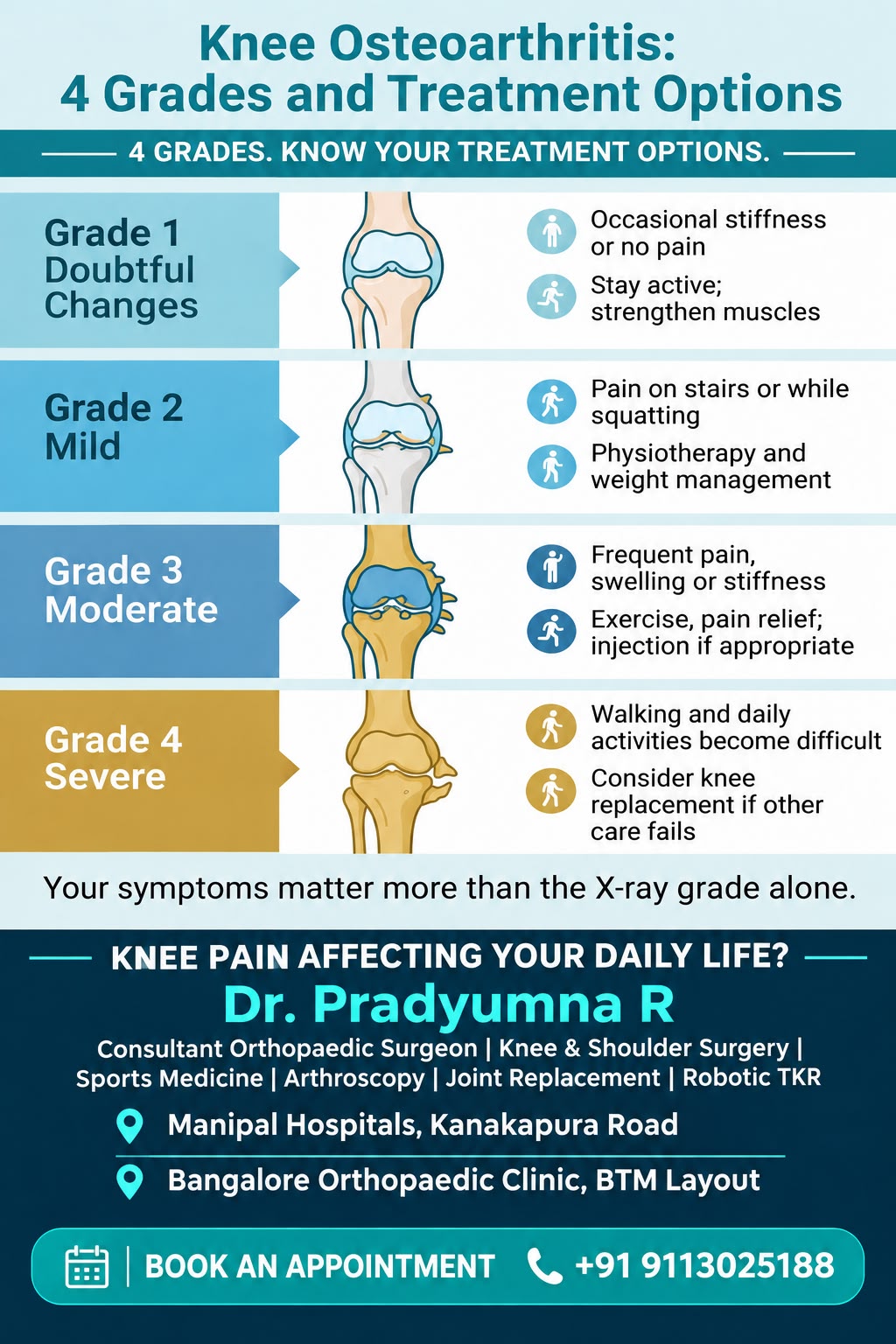
Knee osteoarthritis develops when the cartilage that cushions the knee gradually deteriorates, along with changes in the surrounding joint tissues. Doctors commonly use X-rays to classify these changes into four grades. Understanding these stages can help you recognise symptoms early and explore suitable treatment options before knee pain begins affecting your everyday activities.
How Do Doctors Identify the Stage of Knee Osteoarthritis?
Orthopaedic doctors commonly use the Kellgren–Lawrence grading system, which classifies knee changes from Grade 0 (normal X-ray) to Grade 4 (severe osteoarthritis). A standing, weight-bearing knee X-ray helps assess:
- Narrowing of the space between the knee bones
- Formation of small bony growths called osteophytes
- Changes in the bone beneath the cartilage
- Joint deformity in advanced cases
An important point: The X-ray grade does not always match the amount of pain you experience. Your symptoms, knee movement and ability to perform daily activities are equally important when deciding treatment.
Grade 1: Very Early Changes
What happens? The X-ray may show tiny bone spurs or doubtful early changes. Some patients experience occasional knee discomfort, while others have no symptoms.
Common symptoms:
- Mild discomfort after prolonged walking
- Stiffness after sitting for several hours
- Occasional pain while climbing stairs
Recommended treatment:
At this stage, treatment focuses on improving muscle strength and maintaining joint mobility. Regular walking, cycling, swimming and simple quadriceps-strengthening exercises can help. Weight management is particularly beneficial for patients who are overweight. Injections or surgery are generally unnecessary for Grade 1 changes alone.
Grade 2: Mild Knee Osteoarthritis
What happens? Small bone spurs become more clearly visible on X-rays. Early narrowing of the joint space may also appear.
Common symptoms:
- Knee pain while climbing or descending stairs
- Discomfort while squatting or sitting cross-legged
- Stiffness after long periods of sitting
- Occasional swelling after increased activity
Recommended treatment:
Physiotherapy and exercises to strengthen the thigh and hip muscles remain the first line of treatment. Patients may also benefit from weight reduction, activity modifications and topical antiinflammatory medicines prescribed by their doctor. If sitting on the floor or using an Indian-style toilet causes significant discomfort, temporarily switching to a chair or Western-style toilet may reduce strain. Complete rest is usually not advised because reduced activity can weaken the muscles supporting the knee.
Grade 3: Moderate Knee Osteoarthritis
What happens? X-rays show definite joint-space narrowing, multiple bone spurs and changes in the underlying bone.
Common symptoms:
- Frequent knee pain during daily activities
- Difficulty getting up from the floor
- Pain during household chores or prolonged standing
- Reduced walking distance
- Repeated swelling or stiffness
Recommended treatment:
Treatment generally includes structured physiotherapy, weight management and appropriate pain-relieving medicines. A walking stick or selected knee brace may help certain patients. For persistent symptoms, a corticosteroid injection may provide temporary relief. However, injections do not regenerate worn cartilage. If knee pain continues despite appropriate treatment, an orthopaedic surgeon may discuss additional options based on the patient’s symptoms, knee alignment and overall joint condition.
Grade 4: Severe Knee Osteoarthritis
What happens? There is marked narrowing of the joint space, larger bone spurs and significant changes in the surrounding bone. Some patients may develop bow-legged or knock-kneed deformity.
Common symptoms:
- Severe pain even during short walks
- Difficulty climbing stairs or standing for long
- Pain that disturbs sleep
- Significant stiffness and reduced knee movement
- Difficulty performing routine household activities
Recommended treatment:
Non-surgical treatments may still help manage symptoms. However, when knee pain severely affects daily life and suitable non-surgical treatments have not provided adequate relief, total knee replacement surgery may be considered. Not every patient with Grade 4 osteoarthritis requires immediate surgery. The decision depends on pain, functional limitations, general health and individual treatment goals.
Frequently Asked Questions About Knee Osteoarthritis
1. What are the four stages of knee osteoarthritis?
Grade 1 represents doubtful early changes, Grade 2 mild changes, Grade 3 moderate changes and Grade 4 severe changes. Doctors assess these stages through X-rays along with symptoms and clinical examination.
2. How do doctors grade knee osteoarthritis on an X-ray?
Doctors assess joint-space narrowing, bone spurs, changes in the underlying bone and joint deformity. Standing knee X-rays are commonly used because they show the joint under body weight.
3. What are the symptoms at each stage of knee arthritis?
Early symptoms may include occasional pain and stiffness. Moderate arthritis can cause frequent pain while walking or climbing stairs. Severe arthritis may affect sleep, mobility and routine activities. Symptoms vary between patients.
4. Can knee osteoarthritis be reversed or stopped from getting worse?
Existing cartilage damage generally cannot be reversed. However, exercise, weight management and appropriate treatment can reduce pain, improve movement and help maintain function. Osteoarthritis does not progress at the same rate in everyone.
5. How fast does knee arthritis progress from Grade 1 to Grade 4?
There is no fixed timeline. Some patients remain at the same grade for years. Progression depends on factors such as body weight, previous knee injuries, joint alignment and overall health.
6. What is the best treatment for Grade 2 and Grade 3 knee osteoarthritis?
Physiotherapy, muscle-strengthening exercises, weight management and appropriate pain relief are usually recommended first. Additional treatment depends on symptom severity and response to conservative care.
7. At what stage is knee replacement needed?
Knee replacement is commonly considered in advanced arthritis when pain and restricted movement significantly affect daily life despite appropriate non-surgical treatment. X-ray grade alone does not determine the need for surgery.
8. Do PRP, hyaluronic acid or steroid injections help at each stage?
Steroid injections may provide short-term pain relief. Hyaluronic acid injections are not routinely recommended because benefits are inconsistent. Evidence for PRP remains uncertain, and guidelines differ. None reliably restores damaged cartilage.
9. Which exercises and lifestyle changes help knee arthritis?
Walking on even surfaces, swimming, stationary cycling and strengthening the quadriceps are useful options. Maintaining a healthy weight and modifying painful activities such as repeated deep squatting can also help.
10. When should I see an orthopaedic doctor for knee arthritis in Bangalore?
Consult an orthopaedic doctor if knee pain persists for several weeks, frequently requires painkillers or affects walking, stairs, sleep or household activities. Sudden severe swelling, fever or inability to bear weight requires urgent assessment.
Conclusion
Knee Osteoarthritis Treatment in Bangalore
Knee osteoarthritis does not always mean knee replacement surgery. Many patients, particularly in the earlier stages, can manage symptoms effectively through exercise, physiotherapy, lifestyle modifications and appropriate medical care. The most important step is understanding the condition of your knee and choosing treatment based on your symptoms rather than relying on the X-ray grade alone.
Dr. Pradyumna R, Consultant Orthopaedic Surgeon specialising in knee and shoulder surgery, arthroscopy, sports medicine and joint replacement, provides evaluation and treatment for knee osteoarthritis in Bangalore.
Consultation locations:
Manipal Hospitals, Kanakapura Road, Bangalore
Bangalore Orthopaedic Clinic, BTM Layout, Bangalore
Appointments: +91 9113025188
If knee pain is beginning to interfere with your daily routine, schedule a consultation to understand your treatment options.